
Traditional Moroccan Jewelry: Symbols, Materials and Regional Styles
Traditional Moroccan jewelry is easy to admire for its silver, bright stones, engraved patterns and striking shapes. Yet these pieces were never created only for decoration. Jewelry could identify a region, complete ceremonial clothing, preserve family wealth and carry meanings connected to protection, continuity and belonging.
Understanding traditional Moroccan jewelry reveals the cultural diversity behind Moroccan craftsmanship. A silver fibula from the Atlas Mountains looks very different from a gold head ornament made in an old northern city. Materials, techniques and symbols change from one community to another, turning every piece into part of a much larger historical story.
The Cultural Roots of Traditional Moroccan Jewelry
Moroccan jewelry developed through centuries of exchange between Amazigh, Arab, Andalusian, Jewish, Saharan, Mediterranean and African traditions. Artisans adapted outside materials and techniques while creating styles closely connected to local clothing and community life.
Rural jewelry often had both practical and decorative functions. Large brooches fastened garments, chains joined different pieces, and coins could be incorporated into necklaces or head ornaments. In urban centers, gold, pearls and gemstones appeared more frequently in formal jewelry.
Trade routes also shaped the craft. Coral, amber, glass beads and coins traveled between the Mediterranean, the Sahara and cities across Morocco. Artisans transformed these materials into designs that became associated with particular regions.
Because styles evolved over generations, traditional Moroccan jewelry should not be treated as one fixed category. It is a collection of many local traditions connected by skilled metalwork and the importance of personal adornment.
Jewelry as More Than Decoration
In many Moroccan communities, jewelry communicated information. Its shape, material and method of wear could suggest the wearer’s region, family background, social position or stage of life.
Jewelry also played a role in important occasions such as weddings, religious holidays and seasonal celebrations. A complete ceremonial outfit might include necklaces, earrings, bracelets, head ornaments and garment fasteners.
Some pieces were passed from mothers to daughters or between other relatives. They carried memories of family celebrations and could remain in a household for generations.
Metal jewelry also represented stored value. Silver coins and substantial ornaments could function as portable family wealth. This practical importance helps explain why older Moroccan jewelry can be both visually impressive and relatively heavy.
Why Silver Is Important in Moroccan Jewelry
Silver is strongly associated with Amazigh jewelry and the craft traditions of southern and mountainous Morocco. It can be shaped, engraved, pierced, joined and decorated in many ways, making it suitable for both large statement pieces and small detailed ornaments.
Historically, silver jewelry appeared in communities across the Atlas Mountains, the Souss and southern Morocco. Cities including Tiznit, Taroudant, Guelmim, Essaouira and Agadir remain known for silver craftsmanship and markets.
The surface may be brightly polished or intentionally darkened to make engraved lines more visible. Some pieces combine silver with enamel, coral, amber, glass or old coins.
Silver’s cultural meaning is not identical everywhere. In some interpretations, its light color has been associated with purity or positive qualities. More broadly, it became a familiar material through which families expressed regional identity and artisan skill.
Gold in Urban Moroccan Jewelry
Gold has traditionally appeared more often in urban jewelry, particularly in formal pieces connected to wealthy households, weddings and important celebrations.
Historic craft centers such as Fes, Tetouan and Tangier produced sophisticated head ornaments, earrings, necklaces and other pieces. Designs could include filigree, pearls, colored stones, glass and detailed metalwork.
Urban jewelry was worn by both Muslim and Jewish Moroccan communities, and artisans created pieces for clients from different cultural backgrounds. Moroccan Jewish metalsmiths and jewelers made important contributions to the country’s jewelry traditions, including pieces in Amazigh styles.
Gold remains closely associated with wedding jewelry and ceremonial clothing. However, modern pieces may use gold-plated metal or other materials to provide a similar appearance at a more accessible price.
Coral, Amber, Glass and Other Materials
Traditional Moroccan jewelry often combines metal with materials that add color, texture and meaning.
Common examples include:
- Coral
- Amber
- Colored glass beads
- Enamel
- Pearls
- Semi-precious stones
- Shells
- Coins
Red coral was highly valued and often appeared in silver jewelry. Because genuine coral was expensive, artisans also used glass and later synthetic substitutes to create a similar visual effect.
Amber beads brought warm yellow and orange tones to necklaces, especially in southern traditions. Colored glass offered a wide range of shades and made elaborate jewelry available to more families.
Coins added movement, sound and visible value. Moroccan coins were common, but older Spanish, French and other currencies could also be reused after moving through trade networks.
The material of an old piece can therefore reveal both local taste and Morocco’s historical connections with distant regions.
The Tizerzai: Morocco’s Traditional Fibula
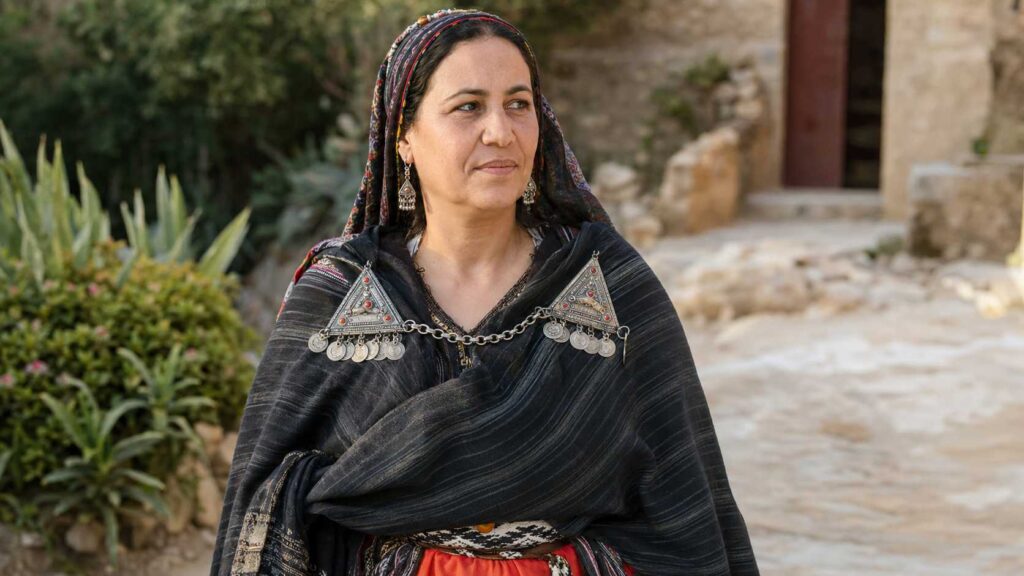
One of the most recognizable forms of traditional Moroccan jewelry is the fibula, often called tizerzai or by related regional names.
A fibula is a large decorative pin used to fasten a draped garment at the shoulder. It is practical, but its size and decoration also make it a major part of the outfit.
Many Moroccan fibulae have a triangular form. They may be worn as a pair and connected by a chain across the chest. Pendants, beads or an amulet case can be attached to the chain.
Examples differ greatly between regions. Some are plain and strongly geometric, while others feature enamel, coral, stones, coins or complex silver work. A particular shape may be linked to a specific community, such as pear-shaped fibulae associated with Zayan Amazigh groups in the Middle Atlas.
The tizerzai demonstrates how traditional Moroccan jewelry combines function, identity and beauty in a single object.
The Khmissa or Hand Symbol
The hand-shaped symbol known as the khmissa or hamsa appears in jewelry and decorative art across Morocco and other parts of North Africa and the Middle East.
It is generally associated with protection and positive blessing. The name khmissa is connected to the number five, reflecting the five fingers of the hand.
Khmissa pendants may be simple or heavily decorated. Some contain engraved lines, floral designs, colored stones or an eye-like motif.
The symbol is shared across cultural and religious communities, although people may explain its meaning in different ways. It is therefore better understood as a widely recognized protective form rather than a symbol with only one fixed interpretation.
Today, the khmissa appears in both traditional and contemporary jewelry. Its continued popularity shows how an old motif can remain culturally meaningful while adapting to modern design.
Geometric Motifs and Their Meanings
Triangles, diamonds, circles, zigzags and repeated lines frequently appear in traditional Moroccan jewelry.
Geometric patterns are visually effective on metal because they can be engraved, pierced or repeated around the shape of an ornament. They also connect jewelry with motifs seen in carpets, embroidery, pottery and architecture.
Some designs are interpreted as symbols of protection, fertility, balance, continuity or the natural world. However, meanings can change according to the region, the artisan and the family using the piece.
Not every triangle or diamond carries a secret message. Sometimes a form is selected because it belongs to a local artistic tradition or works well within the composition.
Respectful interpretation therefore requires caution. Asking knowledgeable artisans or community members is more reliable than assigning a universal meaning to every pattern.
Eye, Star and Plant-Inspired Designs
Eye-like forms are often connected with ideas of protection from envy or negative attention. They may appear alone or inside the khmissa.
Stars and rosettes provide balanced shapes that work naturally in circular pendants, fibulae and earrings. Floral patterns became especially important in some urban and Andalusian-influenced crafts.
Other motifs may resemble leaves, seeds, branches or small animals. These designs can reflect the landscape and everyday life of the communities where they developed.
As with geometric patterns, interpretation should remain flexible. A motif may carry symbolic meaning in one context and serve mainly as decoration in another.
This flexibility is part of the richness of traditional Moroccan jewelry. Its visual language is shared, but never completely uniform.
Metal Engraving and Traditional Craftsmanship
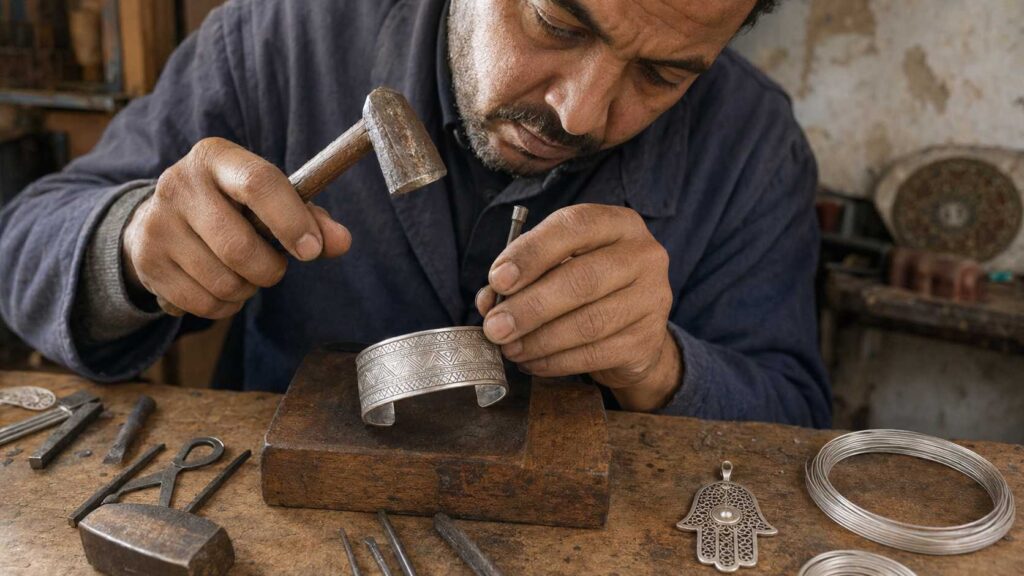
Engraving is one of the central techniques used in Moroccan metalwork. Artisans cut lines, words, symbols or patterns into the surface of gold, silver or copper.
Other jewelry techniques may include:
- Filigree made from fine metal wire
- Enameling with colored glass-like material
- Piercing and openwork
- Hammering and shaping
- Setting stones or glass
- Joining chains and pendants
- Creating raised dots and textured surfaces
Each technique requires precision and experience. A complex ornament may pass through several stages before polishing and final assembly.
In 2023, UNESCO added “Arts, skills and practices associated with engraving on metals” to its Representative List of the Intangible Cultural Heritage of Humanity. Morocco participated in this multinational recognition alongside other countries where the craft remains active.
The inscription recognizes the knowledge transmitted by artisans, not only the finished objects.
Tiznit and the Silver Tradition of the Souss
Tiznit is one of Morocco’s most famous centers for silver jewelry. Located in the Souss-Massa region, the city has a medina filled with jewelers and shops displaying fibulae, pendants, earrings, bracelets and necklaces.
Jewelry from Tiznit and surrounding areas often combines silver with coral-colored details, glass beads, enamel or amber. Large geometric pieces reflect the visual strength of southern Amazigh traditions.
Nearby cities such as Taroudant and Inezgane also have active jewelry markets. Agadir’s museums and cultural spaces preserve examples from the wider region.
Tiznit’s reputation comes not only from selling jewelry but also from maintaining craft knowledge. Workshops and family businesses continue to produce both traditional pieces and modern designs inspired by older forms.
For travelers interested in traditional Moroccan jewelry, Tiznit offers an opportunity to see how regional heritage remains part of a living economy.
Jewelry of the Middle Atlas
The Middle Atlas is home to several Amazigh communities with distinctive jewelry traditions. Silver, coins, enamel and colored stones may appear in large functional ornaments.
Zayan fibulae are known for recognizable regional forms, including examples with pear-shaped central sections. Chains holding coins could join pairs of fibulae and add sound as the wearer moved.
Head ornaments, necklaces and earrings completed traditional clothing. Their forms were connected to locally woven garments and the practical needs of mountain life.
Today, historic Middle Atlas jewelry is often found in museum collections and family inheritances. Contemporary artisans may reproduce its shapes in lighter pieces that are easier to wear with modern clothing.
Northern Moroccan and Rif Styles
Northern Morocco developed jewelry traditions influenced by Mediterranean trade, Andalusian culture and the urban centers of Tetouan and Tangier.
Gold and filigree are more visible in some northern urban styles than in the large silver jewelry of the south. Pearls, colored stones, floral shapes and fine metalwork may appear in formal head ornaments and earrings.
Rural Rif traditions have their own combinations of silver, beads, coins and textile decoration. As elsewhere in Morocco, there is no single northern style.
The region’s jewelry demonstrates how city workshops and rural communities influenced one another while maintaining different preferences in material and form.
Jewelry of Southern and Saharan Morocco
Southern Morocco was connected to trans-Saharan trade routes that carried materials, techniques and artistic ideas across a wide area.
Jewelry from oasis and Saharan communities may include silver, amber, shells, glass beads, leather and coins. Large necklaces and head ornaments can create strong combinations of color and texture.
The materials often reveal movement between Morocco, the Sahel and Mediterranean markets. An imported bead could become part of a locally designed piece and take on new family or regional meaning.
Because communities across the south are diverse, terms such as “desert jewelry” can be too general. Jewelry from the Draa Valley, Guelmim or other southern areas should be appreciated within its specific local context.
Traditional Moroccan Jewelry at Weddings
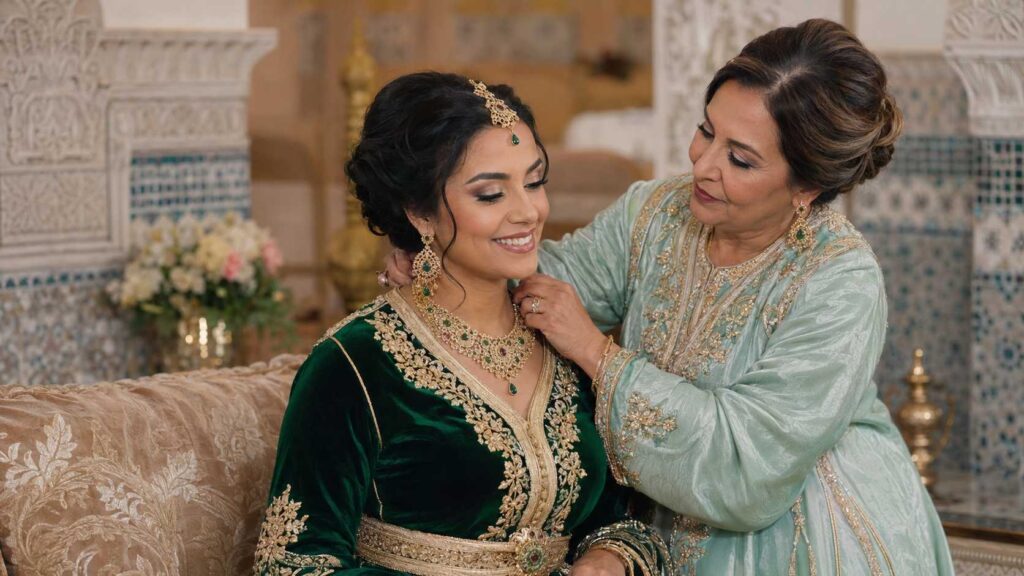
Jewelry plays an important role in Moroccan wedding clothing. Brides may wear coordinated necklaces, earrings, bracelets, belts and head ornaments with a caftan or takchita.
The exact selection depends on the region, family tradition and style of the celebration. Some brides wear modern gold jewelry, while others include inherited pieces or ornaments inspired by regional heritage.
Jewelry can also appear during henna ceremonies and other stages of the wedding. It helps distinguish the bride’s outfit and adds family history to the celebration.
An inherited necklace or bracelet carries emotional meaning because it connects the new occasion with earlier marriages and relatives.
Jewelry as Family Memory and Portable Wealth
Traditional jewelry could form part of a woman’s personal property and represent financial security. Silver, gold and coins retained material value even when the style changed.
This made jewelry portable wealth as well as personal decoration. A family could preserve value in objects that were worn during important events and stored afterward.
Passing jewelry between generations gave the pieces another type of value. Scratches, repairs or replaced beads could become evidence of a long family history.
Modern families may not use jewelry in exactly the same way, but inherited pieces still carry strong memories and cultural meaning.
Traditional Jewelry in Modern Moroccan Fashion
Contemporary designers frequently reinterpret older Moroccan forms. A large fibula may become a smaller pendant, or a heavy silver necklace may inspire a lighter modern version.
The khmissa remains popular in gold, silver and simple everyday jewelry. Geometric Amazigh motifs also appear in rings, earrings and bracelets designed for younger customers.
These changes can help keep the tradition visible. However, responsible design should acknowledge the communities and crafts that inspired it.
Supporting artisans is especially important because handmade techniques require years of learning. When buyers value the skill behind a piece, traditional Moroccan jewelry can continue to evolve without losing its cultural roots.
How Travelers Can Buy Moroccan Jewelry Respectfully
Travelers can find jewelry in medina workshops, artisan cooperatives, specialist boutiques and museum shops. Tiznit, Marrakech, Fes, Essaouira, Taroudant and Agadir are among the places known for jewelry markets or collections.
Before buying, it is helpful to ask:
- Is the piece handmade or machine-produced?
- What metal and decorative materials were used?
- Which region or tradition inspired the design?
- Is it an old piece or a modern reproduction?
- Can the seller explain any marks or repairs?
Buyers should be cautious when a newly made object is presented as an antique. Genuine age can be difficult to judge without specialist knowledge.
A respectful purchase focuses on craftsmanship rather than bargaining only for the lowest price. Buying directly from reputable artisans and cooperatives can help traditional skills remain economically sustainable.
1. What materials are used in traditional Moroccan jewelry?
Traditional Moroccan jewelry may use silver, gold, copper, coral, amber, enamel, glass beads, pearls, shells, semi-precious stones and coins. Silver is especially associated with Amazigh and southern jewelry, while gold appears more often in urban and formal styles.
2. What is a Moroccan fibula?
A Moroccan fibula, often called tizerzai or by a related regional name, is a decorative pin used to fasten a draped garment at the shoulder. Fibulae are commonly made from silver, worn in pairs and sometimes connected by chains with pendants or coins.
3. What does the khmissa mean in Moroccan jewelry?
The khmissa is a hand-shaped symbol generally associated with protection and positive blessing. Its name relates to the number five. The form is shared by different North African cultural and religious communities, although its interpretation can vary.
4. Which Moroccan city is famous for silver jewelry?
Tiznit is Morocco’s best-known center for silver jewelry. Artisans in the city and the wider Souss region create fibulae, necklaces, pendants, earrings and bracelets using traditional techniques and modern adaptations.
5. Does every symbol in Moroccan jewelry have the same meaning?
No. Meanings can change between regions, communities, families and time periods. Some shapes are linked with protection, fertility or continuity, while others may be decorative or identify a local style. Universal explanations should therefore be treated carefully.
Traditional Moroccan jewelry is much more than a collection of beautiful accessories. It reflects regional identity, trade, family memory, craftsmanship and the practical history of clothing. Silver fibulae, gold head ornaments, amber necklaces and engraved pendants each reveal a different part of Morocco’s cultural landscape.
The tradition continues because artisans and designers adapt old forms to modern life. Protecting it requires more than preserving historic pieces in museums; it also means valuing the people who still engrave metal, create filigree and teach these skills to new generations.
Which aspect of traditional Moroccan jewelry interests you most: its symbols, regional differences or the craftsmanship behind each piece?
The tizerzai design is amazing. It’s fascinating how a functional garment pin became such an iconic piece of cultural art.
Great guide! The section on the khmissa symbol was super interesting… it’s amazing how much meaning is woven into these pieces.
Thanks for sharing this! Learning about how families passed down jewelry as history and memory makes these pieces even more special.