
Why Moroccans Eat Couscous on Fridays: The Meaning Behind the Tradition
Couscous holds a central place in Moroccan food culture. More than a traditional dish, it represents family, generosity, patience, and the pleasure of sharing a meal. Although Moroccans enjoy couscous on different occasions, Friday remains the day most closely connected with it.
The Friday couscous tradition in Morocco brings religious rhythm, family life, and culinary heritage together. After the weekly congregational prayer, many families gather around one large dish of steamed couscous, vegetables, broth, and sometimes meat. Understanding this custom reveals why Friday lunch remains such a meaningful moment in Moroccan homes.
Friday Couscous Tradition in Morocco and Its Cultural Origins
The Friday couscous tradition in Morocco has deep roots in North African history. Couscous developed from Amazigh culinary knowledge and became an essential dish across the Maghreb, including Morocco, Algeria, Tunisia, and Mauritania.
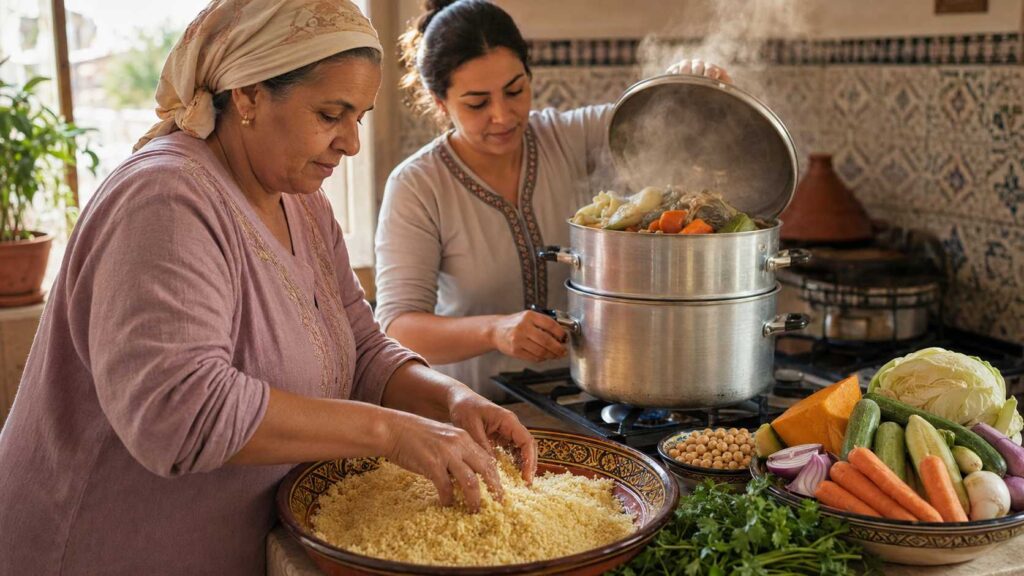
For generations, families have prepared couscous by rolling semolina into small grains and steaming it above a slowly cooking broth. The process requires time, attention, and practical knowledge that was traditionally passed from one generation to another.
In 2020, UNESCO added the knowledge, skills, and practices connected with the production and consumption of couscous to the Representative List of the Intangible Cultural Heritage of Humanity. The recognition emphasized that couscous is not simply a recipe. It is a living social tradition involving preparation, cooperation, and shared meals.
Why Friday Is Important in Morocco
Friday is the main weekly day of congregational prayer in Islam.
Around midday, many Muslim men attend the mosque for the Friday prayer, known as Salat al-Jumu’ah. Families then return home or visit relatives for lunch.
This weekly rhythm makes Friday an ideal day for a special shared meal. In many households, work and school schedules allow relatives to gather more easily than on other days.
Couscous fits this moment because it is designed for sharing. It can feed several people from one large serving dish, making it suitable for parents, children, grandparents, and visiting relatives.
The custom is cultural as well as religious.
Islam does not require Muslims to eat couscous on Fridays. Instead, Moroccan families developed the tradition around the weekly prayer and the importance of gathering together.
Couscous as a Family Meal
Family is one of the strongest reasons the Friday couscous tradition in Morocco continues.
The dish is often placed in the center of the table, allowing everyone to eat together. Some families use individual plates, while others share directly from the same large dish.
The arrangement encourages:
- Conversation
- Cooperation
- Connection between generations
- Respect for shared food
- Time away from individual routines
Friday lunch may be one of the few moments in the week when several family members can sit together without rushing.
Adult children may visit their parents, relatives may bring their children, and neighbors or guests can be invited. The meal creates a regular reason to maintain social relationships.
For many Moroccans, memories of Friday couscous are connected to home. The smell of the broth, the sound of the couscous steaming, and the sight of vegetables arranged above the grains can recall childhood and family gatherings.
How Traditional Moroccan Couscous Is Prepared
Authentic Moroccan couscous is traditionally steamed rather than simply soaked in hot water.
The cook moistens and separates the semolina grains before placing them in the upper section of a couscoussier. Underneath, vegetables and other ingredients cook slowly in a seasoned broth.
The couscous may be steamed several times. Between each steaming, the grains are carefully separated and moistened to create a light texture.
Common ingredients include:
- Carrots
- Turnips
- Pumpkin
- Zucchini
- Cabbage
- Chickpeas
- Onions
- Fresh herbs
- Lamb, beef, or chicken
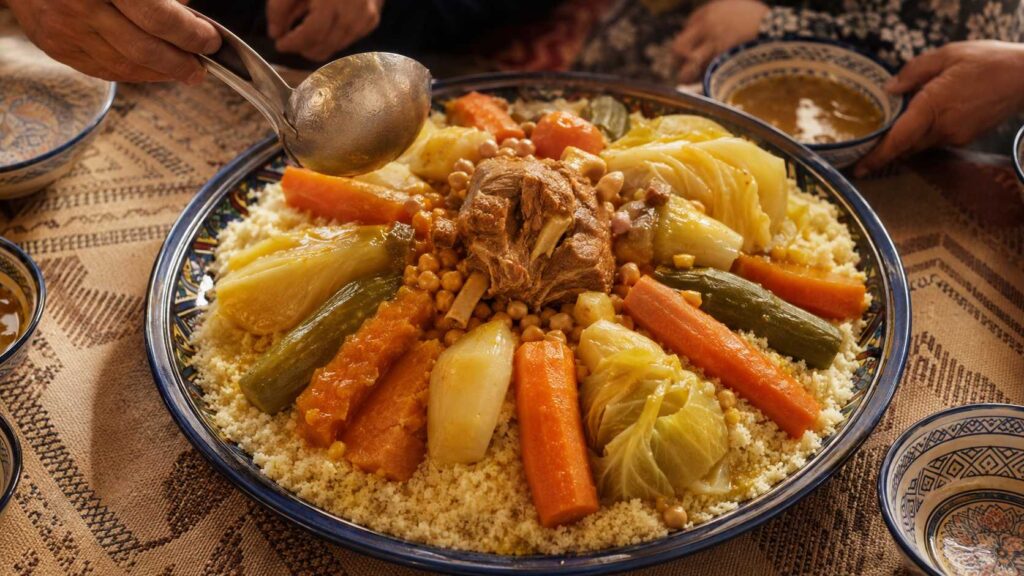
The broth is known as marqa. It adds flavor and moisture when poured over or served beside the couscous.
The exact ingredients depend on the family, season, and region. Vegetarian versions are also common, and some families prepare couscous without meat.
Couscous with Seven Vegetables
One of the best-known Moroccan preparations is couscous with seven vegetables.
The number seven carries positive cultural and symbolic associations in Morocco, although the precise list of vegetables is not fixed. Families use what is seasonal, available, and preferred.
The dish may include carrots, turnips, pumpkin, zucchini, cabbage, tomatoes, and onions, with chickpeas added for extra texture.
Vegetables are arranged carefully over a wide bed of couscous. Meat, when used, is usually placed near the center.
The finished dish is visually generous.
Its size and variety make it appropriate for family gatherings, guests, celebrations, and the traditional Friday meal.
The Social Meaning of Sharing Couscous
Sharing couscous expresses unity.
When several people eat from one dish, each person generally eats from the section directly in front of them. The center may be shared, while the host ensures that guests receive enough vegetables, meat, and broth.
This way of eating requires awareness of others.
People respect the shared space, avoid wasting food, and pay attention to guests. The meal becomes a small demonstration of Moroccan social values.
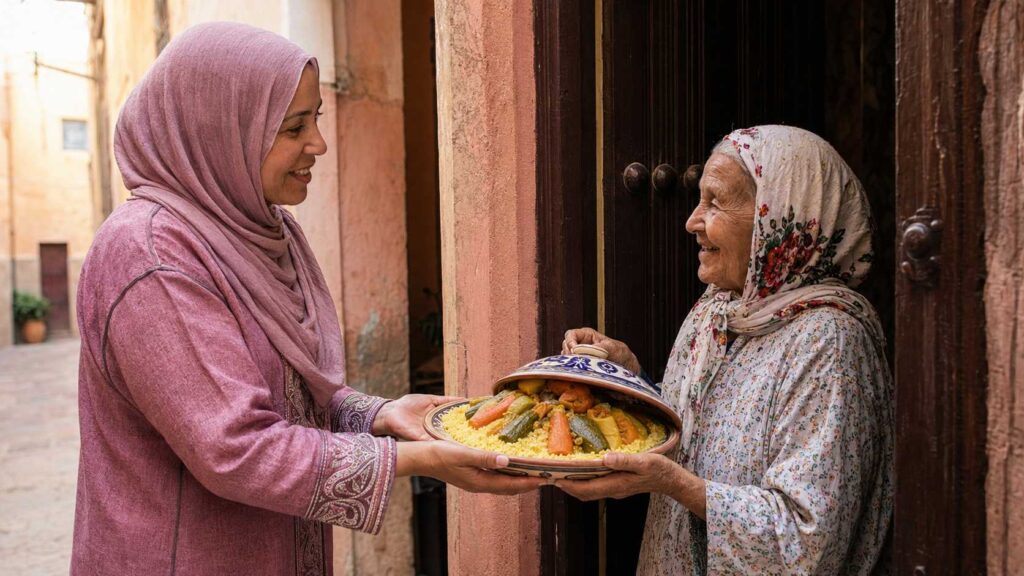
Couscous is also associated with generosity. Preparing a large dish allows a family to welcome an unexpected visitor or send a portion to a neighbor.
In some communities, families share couscous with people who are elderly, living alone, or in need. The Friday meal can therefore extend beyond the household and become an act of solidarity.
Regional Couscous Traditions in Morocco
Moroccan couscous changes across the country.
Climate, agriculture, family heritage, and local ingredients all influence the preparation.
Couscous in the Atlas Mountains
In Amazigh communities of the Atlas Mountains, couscous may be prepared with locally grown vegetables, herbs, barley, or different grains depending on the area.
The dish reflects agricultural life and seasonal availability.
Couscous Tfaya
Couscous tfaya combines savory and sweet flavors.
It is commonly topped with slow-cooked onions, raisins, cinnamon, and other aromatic ingredients. Chicken is often used, although recipes vary.
This preparation is especially popular for celebrations and family occasions.
Couscous in Coastal Regions
Some coastal communities prepare couscous with fish or seafood.
These versions demonstrate how the dish adapts to local geography while preserving the central method of steaming grains and serving them with a flavorful broth.
Couscous in Southern Morocco
Southern families may use local spices, dried ingredients, or grains suited to the region.
The texture, toppings, and level of sweetness can differ from northern and central Moroccan versions.
There is no single recipe that represents every household. Diversity is part of the couscous tradition itself.
The Role of Women in Preserving the Tradition
Historically, women played a major role in preserving couscous knowledge inside Moroccan families.
Girls often learned by watching mothers, grandmothers, aunts, and neighbors. They observed how the grains were rolled, how much water was added, when the couscous was ready for another steaming, and how the vegetables were arranged.
These skills were not always written in recipe books.
They were learned through repetition, memory, and participation.
Today, couscous is prepared by women and men, both at home and professionally. Cooking videos, restaurants, culinary schools, and online recipes have introduced new ways to learn.
However, family knowledge remains important.
Many cooks continue using measurements based on experience rather than exact instructions, giving every household’s couscous a slightly different character.
Friday Couscous in Modern Moroccan Cities
Modern lifestyles have changed how some families prepare Friday couscous.
In cities such as Casablanca, Rabat, Marrakech, and Tangier, working schedules can make a long cooking process difficult. Some people prepare ingredients in advance, use modern kitchen equipment, order from a restaurant, or eat with relatives who have cooked at home.
The form may change, but the social purpose often remains.
Families still use Friday couscous as a reason to meet. Even when the dish is purchased rather than prepared at home, people can gather around it and maintain the weekly tradition.
Younger Moroccans may also adapt recipes by using fewer ingredients, vegetarian combinations, or different presentations.
These changes do not necessarily weaken the tradition. They show how Moroccan food culture continues to adjust to contemporary life.
Is Couscous Only Eaten on Fridays?
Couscous is not limited to Friday.
Moroccans also serve it during:
- Family celebrations
- Weddings
- Religious occasions
- Community gatherings
- Visits from guests
- Special lunches
Some families eat couscous every Friday, while others prepare it less regularly.
Regional habits, work schedules, household size, and personal preference all affect how often it appears.
Travelers should therefore avoid assuming that every Moroccan family follows exactly the same custom. The Friday connection is widespread and culturally important, but it is not an unbreakable rule.
Experiencing Friday Couscous as a Traveler
Travelers can experience the Friday couscous tradition in Morocco through family-run restaurants, riads, cooking classes, local guesthouses, and invitations into private homes.
Friday is often the best day to find traditional couscous on restaurant menus. Some establishments prepare it only once a week because of the time required.
When sharing couscous with a Moroccan family:
- Wait for the host to begin
- Eat from the section in front of you when sharing a dish
- Use your right hand if eating by hand
- Accept additional broth or vegetables politely
- Compliment the cook
- Avoid wasting food
- Ask before taking photographs
Visitors do not need to know every custom in advance. Observing the host and participating respectfully are usually enough.
1. Why Do Moroccans Eat Couscous on Fridays?
Friday is the weekly day of congregational prayer, and many families gather for lunch afterward. Couscous is ideal for this occasion because it can be prepared in a large quantity and shared from one dish. The custom connects the religious rhythm of Friday with family and community life.
2. Is Eating Couscous on Friday a Religious Requirement?
No. Islam does not require Muslims to eat couscous on Friday. It is a Moroccan cultural tradition that developed around the Friday prayer, the weekly family gathering, and the importance of sharing food.
3. What Is Traditional Friday Couscous Made With?
Traditional Moroccan couscous is usually made with steamed semolina, seasonal vegetables, chickpeas, broth, herbs, and sometimes lamb, beef, or chicken. Recipes differ between regions and families. Vegetarian and sweet-savory versions are also prepared.
4. Do All Moroccan Families Eat Couscous Every Friday?
No. The tradition is widespread, but not every household prepares it each week. Work schedules, family size, location, and personal preference influence how often couscous is served. Some families cook it weekly, while others reserve it for occasional gatherings.
5. Where Can Tourists Eat Traditional Friday Couscous?
Travelers can find it in Moroccan restaurants, riads, family-run guesthouses, and cooking classes. Some restaurants serve couscous only on Fridays, so checking ahead is helpful. A genuine family invitation can also provide a respectful and personal experience.
The Friday couscous tradition in Morocco is much more than a weekly menu choice. It brings together culinary knowledge, family relationships, religious rhythm, and the social value of sharing.
Although preparation methods and lifestyles continue to change, couscous remains a connection between generations. Families may cook it traditionally, use modern equipment, order it from a restaurant, or gather at a relative’s home. The essential meaning continues through the act of eating together.
For travelers, Friday couscous offers a deeper understanding of Morocco. It shows how one dish can carry history, hospitality, patience, and community into modern daily life.
Do you think the Friday couscous tradition in Morocco will remain equally important for future generations, or will modern lifestyles change the way families celebrate it?