
Tbourida: The History and Meaning of Morocco’s Equestrian Art
Tbourida Morocco is one of the country’s most impressive living traditions. A line of riders in ceremonial clothing moves across an open arena on richly decorated horses, maintaining close formation before completing the performance in a powerful synchronized finale. The speed and sound immediately capture attention, but the deeper meaning lies in discipline, unity and respect for the horse.
Often seen during moussems, agricultural festivals and national celebrations, Tbourida connects modern audiences with Morocco’s equestrian history. It also brings together horse breeders, riders, craftspeople, families and communities from different regions. Understanding this tradition reveals why it is much more than a public spectacle.
What Does the Name Tbourida Mean?
The name Tbourida is connected to the Moroccan Arabic word “baroud,” meaning gunpowder. It refers to the ceremonial conclusion of the equestrian performance, when the members of a group create one coordinated sound.
International visitors may also hear Tbourida called “Fantasia.” That term became common in foreign descriptions of North African equestrian displays. However, Tbourida is the traditional Moroccan name and better reflects the practice’s local identity.
The name describes only one visible part of the event. A complete Tbourida performance also depends on horsemanship, group discipline, traditional dress, artisan-made equipment and the relationship between riders and their horses.
The Historical Origins of Tbourida Morocco
Tbourida developed from historical equestrian and military practices. It represents a ceremonial version of the movements once associated with mounted groups, including organized charges, disciplined formation and collective action.
Sources generally trace the tradition to the fifteenth or sixteenth century. UNESCO describes Tbourida as a Moroccan equestrian performance dating back to the sixteenth century, while the Moroccan National Tourist Office connects it to the fifteenth century.
Over time, the military function disappeared, but the display survived as an art of celebration and honor. Communities performed it to welcome important guests, mark local festivals and celebrate major events.
The tradition became a way to preserve equestrian knowledge while expressing courage, pride and solidarity. Its historical character remains visible, but modern Tbourida is organized as a cultural performance and regulated competition.
The Sorba: A Team Built on Unity
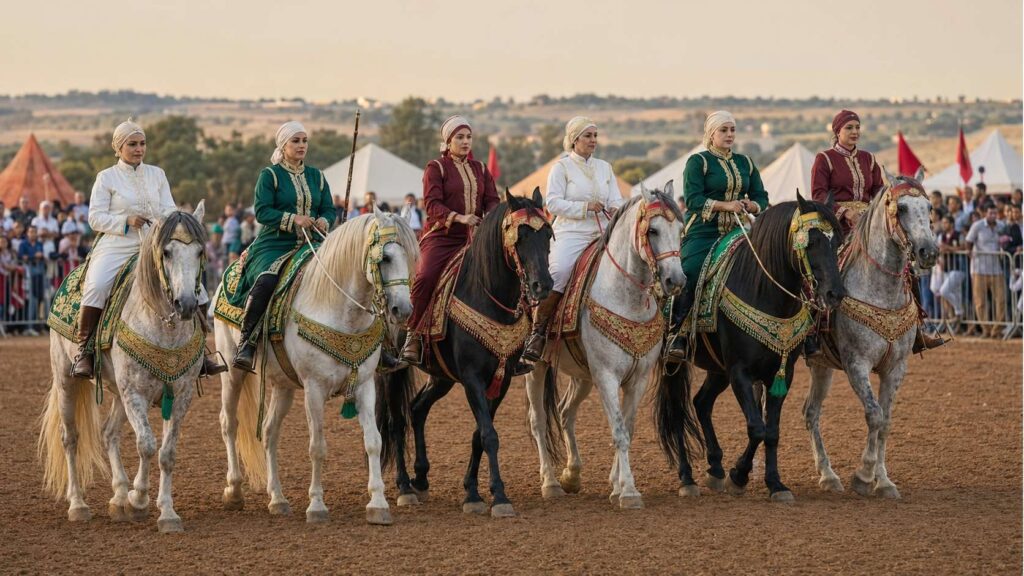
Each Tbourida group is known as a sorba. It consists of a line of riders and horses representing a community, tribe, association or region.
A traditional sorba commonly includes an odd number of participants, often between 15 and 25. The odd number allows the group’s leader to take the central position. Team sizes can vary according to the event category and official competition rules.
The riders must behave as one unit. Their horses should advance in a balanced line, and the group’s movements must remain closely coordinated. Individual skill matters, but it is valuable only when it strengthens the entire formation.
This is one of the central meanings of Tbourida Morocco: collective success is more important than individual display.
The Role of the Mokaddem
The leader of the sorba is called the mokaddem or moqaddem. Positioned near the center of the formation, this person guides the group and helps maintain its timing and order.
The mokaddem is normally an experienced rider with a strong understanding of the horses and the other members of the sorba. Leadership depends on trust because every participant must respond together.
The role also carries social importance. The mokaddem represents the group in front of judges, organizers and spectators. A successful performance reflects not only personal ability but also the leader’s preparation and communication with the team.
In many sorbas, equestrian knowledge is passed through families. Younger riders learn by observing experienced participants and gradually taking on greater responsibility.
How a Tbourida Performance Unfolds
A Tbourida performance takes place in a long open area prepared for the horses. The sorba enters in formation and presents itself before beginning the main display.
The performance is generally understood through two broad phases:
- The opening presentation, often known as the hadda or tahia
- The coordinated equestrian run, commonly called the talqa
During the opening, riders demonstrate the group’s appearance, discipline and control. The main run then brings the horses forward together while the riders try to preserve a straight and balanced formation.
The finale is the best-known moment. The group completes a ceremonial synchronized discharge intended to be heard as one sound. It is performed by trained participants during controlled public events and judged for precision and unity.
The complete display lasts only a short time, yet it represents many hours of preparation.
Why Synchronization Is So Important
The goal of Tbourida is not simply speed. A sorba must move with harmony from the beginning of the run to the final moment.
Judges and experienced spectators pay attention to:
- The unity of the riders’ movements
- The alignment of the horses
- The rhythm of the run
- Communication within the group
- Control and confidence
- Traditional clothing and equipment
- The timing of the ceremonial finale
If one horse moves too far ahead or one rider loses the shared rhythm, the formation becomes less effective. A powerful performance therefore demonstrates patience and teamwork as much as bravery.
The final sound symbolizes that unity. Many individual actions come together so closely that the audience hears them as one.
The Horse at the Center of Tbourida Morocco
The horse is the true center of Tbourida. Moroccan society has a long equestrian tradition, and horses have held important practical, historical and symbolic roles.
Tbourida celebrates the bond between the rider and the animal. A horse must respond calmly within a group, remain focused in a noisy environment and trust the rider. This relationship requires consistent care and patient training.
The performance also gives horse breeders an opportunity to present the qualities of Moroccan breeds. Beauty, strength, balance and responsiveness all contribute to the event.
Respect for the horse is essential to the future of the tradition. Modern preservation efforts increasingly include veterinary care, identification, vaccination and animal-welfare standards at official competitions.
Barb and Arab-Barb Horses
The Barb and Arab-Barb are the breeds most closely associated with Tbourida Morocco. Both are deeply connected to the equestrian heritage of Morocco and the wider Maghreb.
The Barb is known for strength, endurance and adaptability. It has long been used in traditional riding and can perform well across varied terrain.
The Arab-Barb combines characteristics of the Barb and Arabian horse. It is valued for elegance, versatility, responsiveness and resistance to demanding conditions.
Official Moroccan Tbourida competitions require participating horses to meet breed and identification rules. These standards help preserve the role of Barb and Arab-Barb horses while supporting responsible breeding and care.
For spectators, the horses’ decorated appearance is striking. However, their discipline and cooperation with the riders are equally important.
Traditional Clothing Worn by the Riders
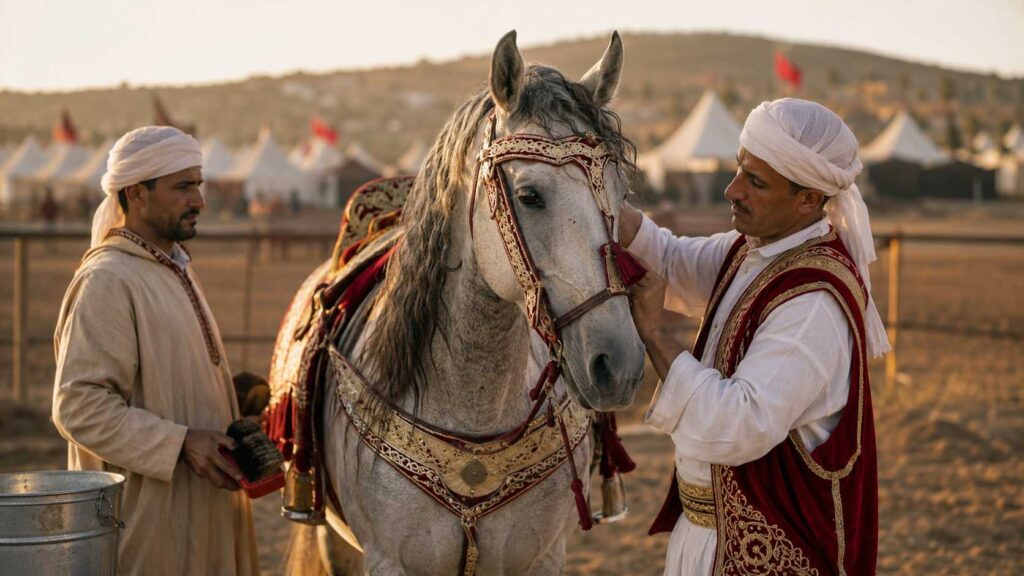
Tbourida clothing contributes strongly to the visual identity of the performance. Riders commonly wear ceremonial garments inspired by the traditional dress of their regions.
An outfit may include:
- A traditional jellaba or flowing garment
- A turban or other regional head covering
- Traditional trousers
- Leather slippers or riding boots
- A cross-body bag or decorative accessories
Colors and details can differ between sorbas. Some groups use white as the main color, while others introduce red, green, blue or embroidered elements representing local identity.
The clothing must appear elegant as a group. At competitions, judges may consider the condition, harmony and authenticity of the riders’ outfits.
Saddles, Harnesses and Moroccan Craftsmanship
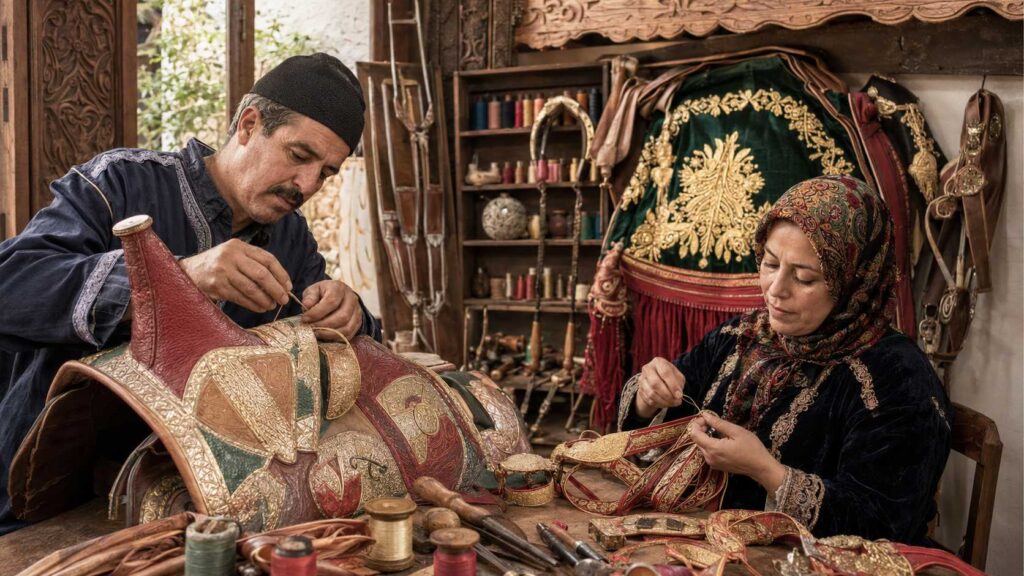
Tbourida also supports several forms of traditional craftsmanship. The horses wear decorated saddles, bridles, embroidered covers and other ceremonial equipment made by specialized artisans.
Leatherworkers, saddle makers, embroiderers, metal engravers and tailors may all contribute to the final appearance. Their work combines practical knowledge with decorative art.
A saddle must be suitable for the horse and rider while matching the visual identity of the sorba. Embroidery, colored leather, metal details and geometric patterns can transform the equipment into a work of art.
The ceremonial accessories carried by riders are also often decorated by craftspeople. Their cultural value comes from design and symbolism, not only from their role in the performance.
In this way, Tbourida Morocco preserves more than horsemanship. It helps sustain a network of traditional trades.
Tbourida at Moussems and Festivals
Moussems are traditional gatherings that may combine religious, agricultural, commercial and cultural activities. Tbourida is a major attraction at many of these events.
Families travel from surrounding villages to watch sorbas perform, visit market stalls and participate in local celebrations. The equestrian program often becomes a meeting point for different generations.
Tbourida can also appear at:
- Agricultural fairs
- Horse festivals
- National celebrations
- Cultural exhibitions
- Regional competitions
- Important community occasions
The atmosphere varies from one event to another. A rural moussem may feel closely connected to local family life, while a national competition may feature formal judging and sorbas from many regions.
Regional Identity and Different Styles
Tbourida is practiced in rural areas across Morocco, but each region may bring its own clothing, horse equipment, colors and performance style.
A sorba represents more than its riders. It can carry the reputation and traditions of an entire community. Families may support the group, help care for the horses and contribute to the cost of clothing or equipment.
Regional diversity is especially visible when several sorbas meet at a large festival. Spectators can compare embroidery, saddles and ceremonial presentation while recognizing the same basic tradition.
This balance between shared rules and local identity helps explain why Tbourida remains important across the country.
Women in Modern Tbourida
Although Tbourida was historically associated mainly with male riders, women now participate in performances and competitions as well.
Female sorbas and individual women riders have become increasingly visible at Moroccan equestrian events. Their participation shows that a living tradition can preserve its heritage while creating space for new generations.
Women riders follow the same principles of discipline, horsemanship and teamwork. They also contribute to transmitting equestrian knowledge and encouraging more young people to value the tradition.
This development does not remove Tbourida’s historical identity. Instead, it demonstrates its ability to remain meaningful in modern Moroccan society.
Tbourida as a Modern Competition
Tbourida is both a cultural performance and a competitive equestrian discipline. Regional events allow sorbas to demonstrate their skills before selected groups advance to major national competitions.
Judging considers the full performance rather than only the finale. Presentation, clothing, saddle decoration, formation, rhythm, horse control and synchronization all matter.
The Hassan II Trophy for Traditional Equestrian Arts is one of the country’s best-known Tbourida competitions. It brings together high-level sorbas and highlights the dedication required to maintain the tradition.
Competition encourages teams to improve, but it also helps establish rules for safety, horse welfare and fair evaluation.
UNESCO Recognition of Tbourida
In 2021, UNESCO inscribed Tbourida on the Representative List of the Intangible Cultural Heritage of Humanity.
The inscription recognizes Tbourida as living cultural knowledge rather than simply a historical show. It includes the performance, horsemanship, oral traditions, clothing, craftsmanship and community practices that surround it.
UNESCO recognition also emphasizes transmission. Riders, horse breeders, artisans and families all help pass the tradition to future generations.
The international recognition increased attention around Tbourida Morocco, but its survival still depends on local communities continuing to practice and value it.
What Tbourida Symbolizes in Moroccan Culture
Tbourida expresses several values at the same time. It represents courage because riders must remain calm and controlled in a demanding performance. It symbolizes discipline because success depends on precise collective movement.
It also communicates hospitality and honor. Historically inspired displays could welcome important guests, and modern performances still mark occasions of pride and celebration.
Most importantly, Tbourida represents unity. A sorba succeeds when riders and horses act together. The final moment has meaning because separate individuals create one coordinated result.
For many communities, participating in Tbourida is therefore a public expression of belonging, memory and regional pride.
What Travelers Should Know Before Watching Tbourida
Travelers can experience Tbourida at selected moussems, horse festivals, agricultural fairs and official competitions. Event dates may change, so checking with local tourism offices or organizers is useful.
Spectators should remain behind designated barriers and follow all instructions from event staff. The horses move quickly, and the ceremonial finale is extremely loud. Hearing protection can be helpful, especially for children or anyone sensitive to noise.
Photography is usually popular, but visitors should respect restricted areas and avoid distracting riders or horses. A zoom lens can help capture the event without approaching the arena.
Arriving early provides time to see the decorated horses, clothing and artisan details before the main performances begin.
Preserving Tbourida for Future Generations
The future of Tbourida depends on more than organizing festivals. Horses require daily care, riders need long-term training and artisan equipment can be expensive to produce.
Supporting breeders, craftspeople and local equestrian associations helps maintain the whole cultural system. Training programs can also teach younger riders about responsibility, animal welfare and the meaning of the tradition.
Documentation is equally important. Recording regional clothing, terminology, oral history and craft methods can protect knowledge that might otherwise disappear.
Tbourida remains powerful because it is practiced rather than only remembered. Preservation should allow the tradition to develop while keeping its values of unity, horsemanship and community pride.
1. What is Tbourida in Morocco?
Tbourida is a traditional Moroccan equestrian performance in which a sorba of riders moves in coordinated formation on decorated horses and completes a synchronized ceremonial finale. It represents historical equestrian practices, teamwork, regional identity and respect for the horse.
2. Why is Tbourida also called Fantasia?
“Fantasia” became a common foreign name for North African equestrian displays and can be translated as entertainment or spectacle. Tbourida is the traditional Moroccan name and is generally preferred when discussing the country’s cultural practice.
3. Where can travelers see Tbourida in Morocco?
Travelers may see Tbourida at moussems, agricultural festivals, horse fairs, regional celebrations and official competitions. Programs vary by year and location, so visitors should confirm dates with reliable local organizers.
4. What horses are used for Tbourida?
Barb and Arab-Barb horses are the breeds most strongly associated with Tbourida Morocco. They are valued for their endurance, adaptability, responsiveness and close connection to Moroccan equestrian heritage.
5. Is Tbourida recognized by UNESCO?
Yes. UNESCO inscribed Tbourida on the Representative List of the Intangible Cultural Heritage of Humanity in 2021. The recognition covers the performance and the cultural knowledge, craftsmanship and community traditions connected to it.
Tbourida Morocco is much more than an exciting equestrian display. It combines history, teamwork, horse breeding, traditional dress and artisan craftsmanship in one living cultural practice. Every sorba represents a community, and every successful performance depends on trust between riders, horses and their leader.
Its UNESCO recognition confirms its international cultural importance, but the tradition remains deeply local. It survives through families who care for horses, artisans who create ceremonial equipment and riders who pass their knowledge to younger generations.
When you watch Tbourida, which part carries the strongest cultural meaning for you: the horses, the craftsmanship or the unity of the sorba?