
Photogenic Morocco: Top Spots for Travel Photography
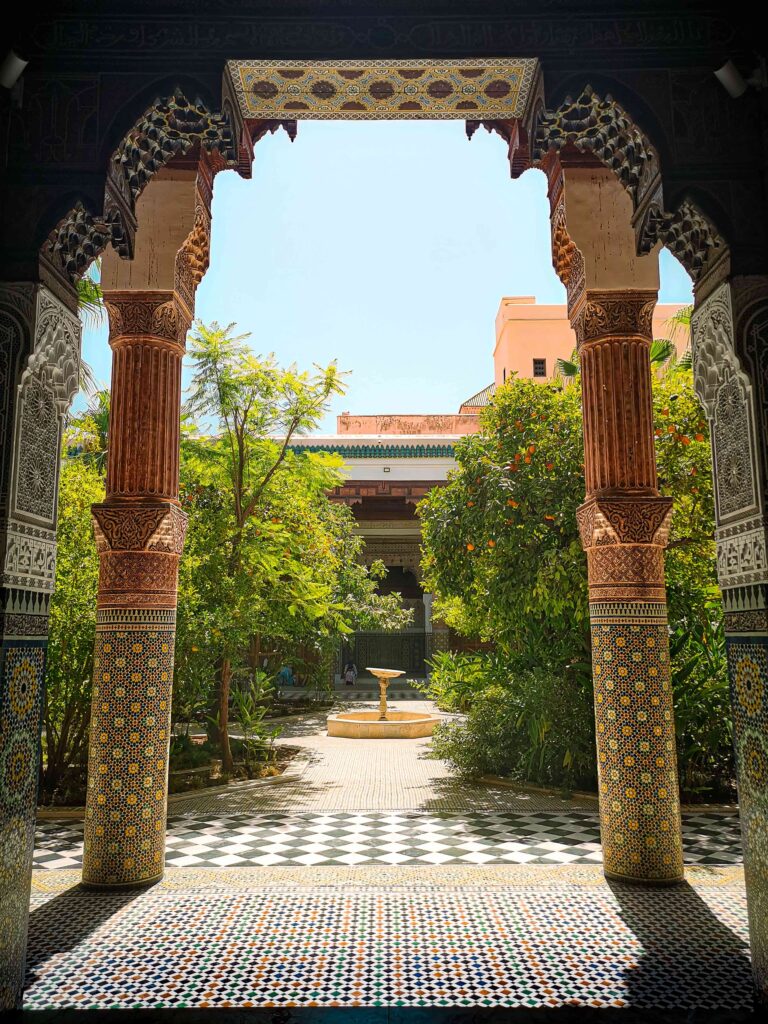
Morocco is one of the most photogenic countries in North Africa. From the blue streets of Chefchaouen and the colorful souks of Marrakech to the golden dunes of the Sahara, the country offers an extraordinary variety of landscapes, architecture, people, and cultural scenes to photograph.
For photographers and travelers, Photogenic Morocco: Top Spots for Travel Photography is more than a list of beautiful places. Morocco offers opportunities to capture changing light, traditional architecture, mountain landscapes, desert scenery, coastal towns, historic medinas, and everyday moments of Moroccan life.
The country’s visual diversity means that almost every region offers something different. You can photograph sunrise over the dunes in Merzouga, dramatic mountain landscapes in the High Atlas, blue-painted streets in Chefchaouen, ancient kasbahs near Ouarzazate, colorful architecture in Marrakech, or Atlantic sunsets in Essaouira.
But getting great travel photographs in Morocco is not only about finding the right location. Timing, light, composition, cultural awareness, weather, and the way you interact with local communities can make a significant difference.
Whether you use a professional camera, mirrorless system, compact camera, or smartphone, this guide explores the best photography spots in Morocco and provides practical tips to help you capture memorable images while traveling responsibly.
Photogenic Morocco: Top Spots for Travel Photography in Marrakech
Marrakech is one of the best places to begin a Morocco photography journey.
Known as the Red City, Marrakech combines historic architecture, colorful markets, gardens, palaces, narrow medina streets, and vibrant public spaces.
The contrast between terracotta walls, colorful textiles, carved doors, and dramatic Moroccan light creates endless photographic opportunities.
Jemaa el-Fnaa
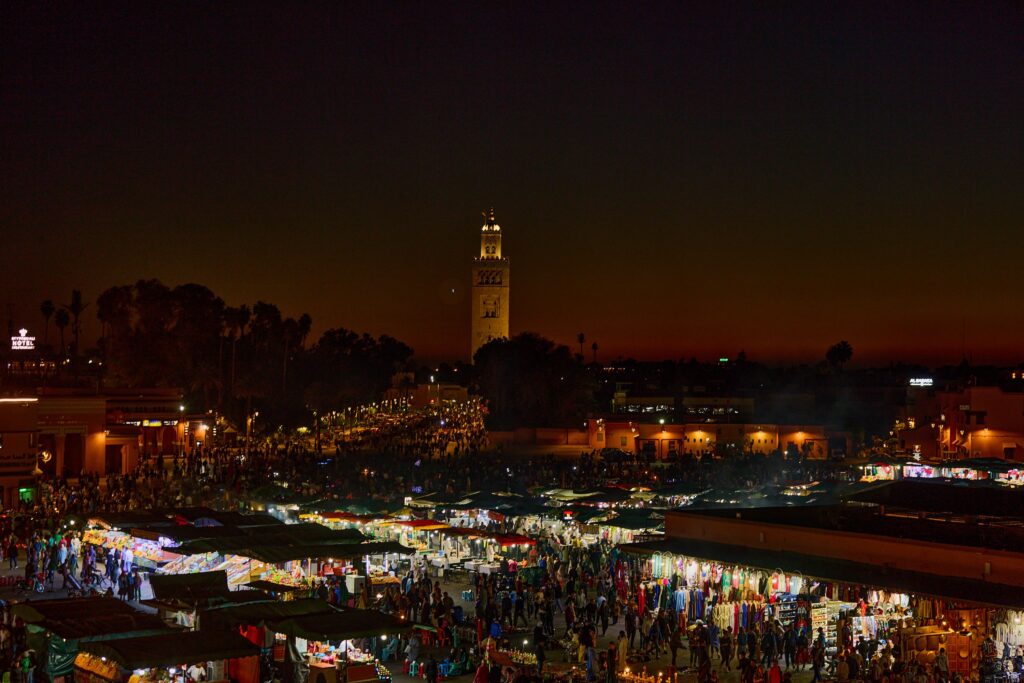
The famous Jemaa el-Fnaa square is one of Marrakech’s most recognizable locations.
During the day, the square changes constantly as vendors, performers, food stalls, locals, and visitors move through the space.
At sunset, the atmosphere becomes particularly photogenic as warm light spreads across the surrounding buildings.
For street photography, try observing rather than immediately photographing.
Look for interesting compositions involving:
- People moving through the square
- Food stalls
- Architectural details
- Shadows
- Silhouettes
- Market activity
- Changing evening light
Always respect people’s privacy and ask permission before taking close-up portraits.
Marrakech Medina
The narrow streets of the medina are ideal for detail photography.
Look for:
- Colorful doors
- Lanterns
- Textiles
- Traditional architecture
- Mosaic tiles
- Wooden balconies
- Shadows between buildings
- Small shops
The strongest images often come from looking beyond the obvious tourist scenes.
Instead of photographing everything, slow down and wait for the right combination of light, movement, and composition.
Bahia Palace
Bahia Palace is another excellent photography location.
Its courtyards, gardens, zellige tilework, carved wooden ceilings, arches, and decorative details showcase traditional Moroccan craftsmanship.
A wide-angle lens can help capture architectural interiors, while a standard or telephoto lens is useful for details.
Majorelle Garden
The Jardin Majorelle provides a completely different visual atmosphere.
Its combination of plants, architectural forms, fountains, and strong color contrasts creates opportunities for creative compositions.
Visit earlier in the day if possible to avoid the strongest crowds and harsh midday light.
Photogenic Morocco: Top Spots for Travel Photography in Chefchaouen
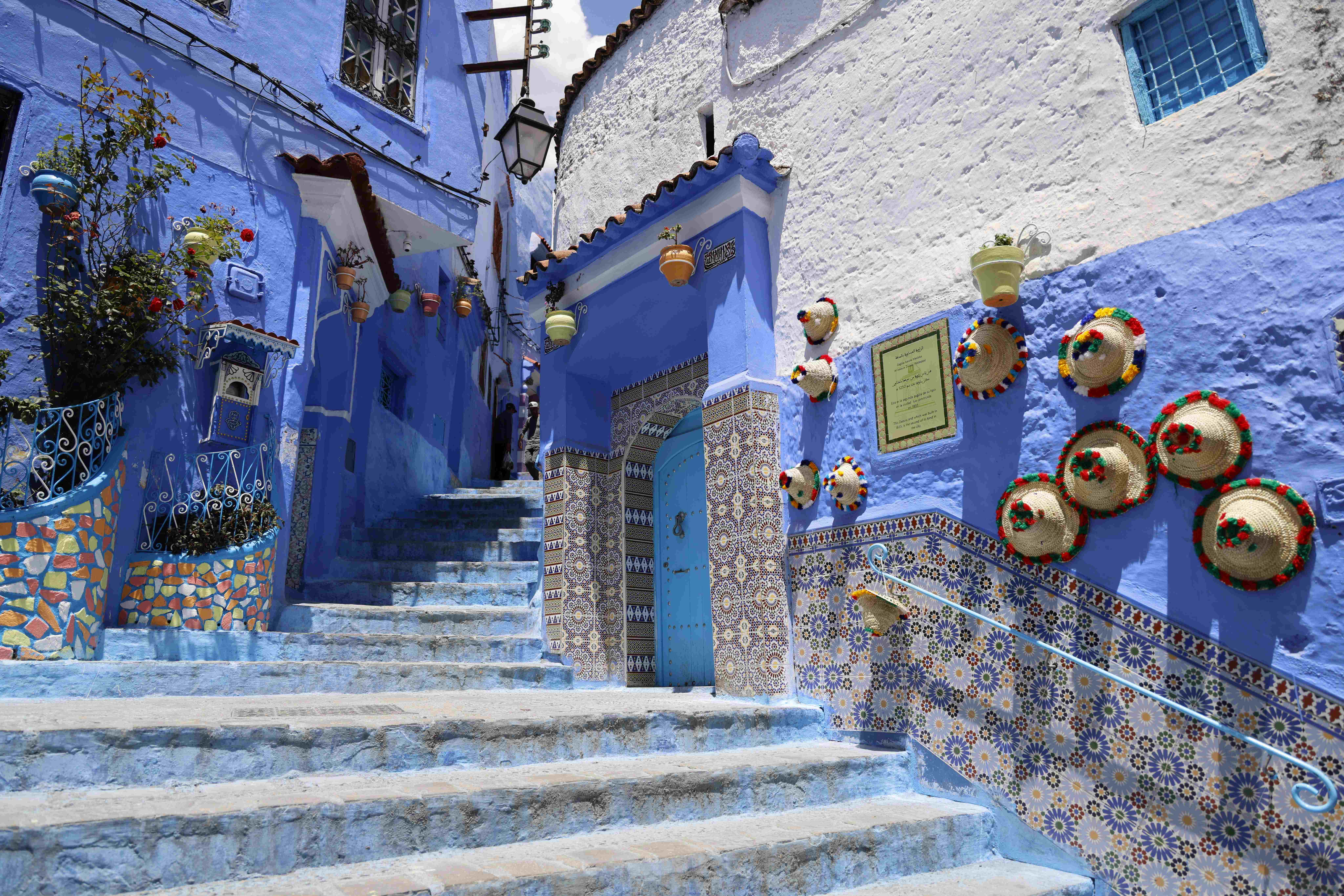
Chefchaouen is arguably one of Morocco’s most recognizable photography destinations.
Located in the Rif Mountains of northern Morocco, the city is famous for its blue-painted medina.
But simply photographing blue walls is not enough to create memorable images.
The blue medina
Chefchaouen’s narrow streets create natural frames and layers.
Look for staircases, doorways, arches, plants, and people moving through the scene.
Different shades of blue can also create depth in your compositions.
Instead of photographing a wall straight-on, experiment with:
- Leading lines
- Symmetry
- Framing
- Reflections
- Shadows
- Repetition
- Human scale
Plaza Uta el-Hammam
The main square provides opportunities for wider environmental photographs.
Photograph the surrounding architecture, cafés, and movement of people while keeping the historical character of the area in mind.
Spanish Mosque viewpoint
For a broader landscape photograph, walk toward the Spanish Mosque viewpoint.
From the hill, you can capture Chefchaouen surrounded by the Rif Mountains.
Sunset is particularly popular because the city and mountains can take on warmer tones.
Photography tip for Chefchaouen
Early morning is often the best time for photographers.
The streets tend to be quieter, and soft light can reveal subtle differences between the blue walls.
It also allows you to photograph the city without large groups of tourists filling the narrow streets.
Photogenic Morocco: Top Spots for Travel Photography in the Sahara Desert
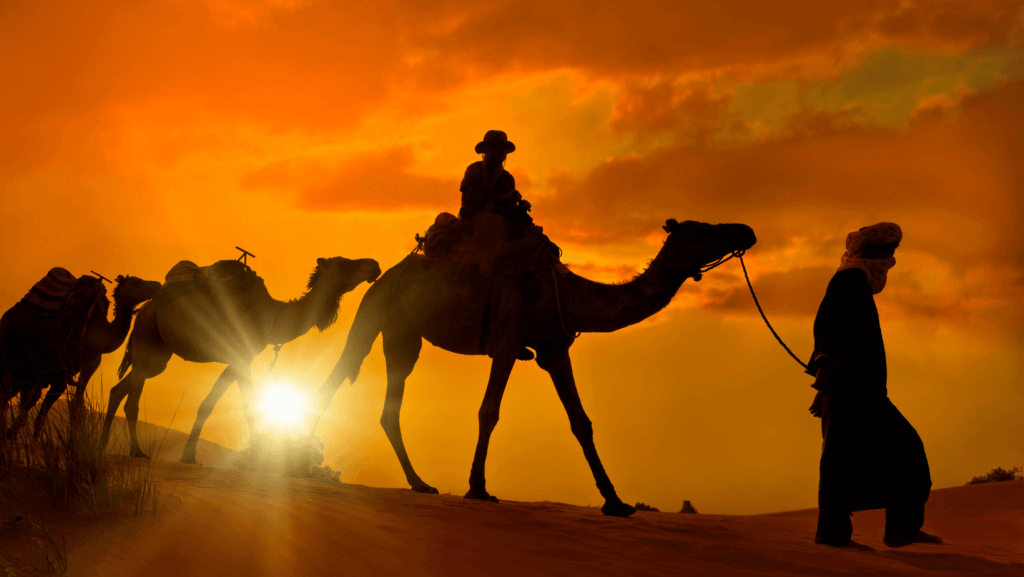
Few Moroccan landscapes are as visually dramatic as the Sahara.
The Erg Chebbi dunes near Merzouga provide enormous golden landscapes that change throughout the day.
For photographers, the desert is particularly rewarding because light and shadow constantly reshape the dunes.
Sunrise in Merzouga
Sunrise is one of the best photography opportunities in the Sahara.
As the sun rises, long shadows create patterns across the sand.
Arrive at your chosen location before sunrise so you have time to prepare.
Use the changing light rather than waiting until the sun is already high.
Sunset over Erg Chebbi
Sunset creates warm tones and dramatic silhouettes.
You can photograph:
- Sand dunes
- Camel caravans
- Desert camps
- Silhouettes
- Footprints
- Textures in the sand
If you are photographing a camel trek, position yourself so the animals and travelers create scale against the dunes.
Night photography in the Sahara
The desert can also be spectacular after dark.
Away from major cities, the sky can offer excellent opportunities for stars and astrophotography when conditions are favorable.
A tripod is essential for long exposures.
Turn off unnecessary artificial lights and allow your eyes to adjust to the darkness.
Photography tip for the Sahara
Sand can be extremely bright during the day.
Check your exposure carefully to avoid losing detail in highlights.
Also protect your equipment from fine sand and dust.
Avoid changing lenses unnecessarily in exposed areas.
Photogenic Morocco: Top Spots for Travel Photography in the Atlas Mountains
Morocco’s Atlas Mountains offer a completely different visual experience from the desert.
Mountain valleys, terraced agriculture, traditional villages, waterfalls, forests, and snow-covered peaks can all appear within the same region.
Imlil and the High Atlas
The village of Imlil is one of the most accessible mountain destinations from Marrakech.
The surrounding valleys provide opportunities to photograph:
- Mountain villages
- Terraced fields
- Walnut trees
- Hiking trails
- Mountain peaks
- Local architecture
- Rural life
For landscape photography, try using a foreground element such as a stone wall, tree, or village path to create depth.
Ourika Valley
The Ourika Valley is another popular photography destination near Marrakech.
Its combination of river landscapes, mountain slopes, traditional villages, and agricultural terraces provides plenty of variety.
Morning and late afternoon can provide softer light.
Tizi n’Tichka Pass
The famous Tizi n’Tichka mountain pass connects Marrakech with the Ouarzazate region.
The road climbs through dramatic High Atlas landscapes, offering numerous viewpoints.
If traveling by private tour, ask your driver or guide about safe places to stop for photographs.
Never stop in unsafe locations simply to capture a particular viewpoint.
Photogenic Morocco: Top Spots for Travel Photography in Aït Ben Haddou and Ouarzazate
Southern Morocco is filled with cinematic landscapes.
The region around Ouarzazate and Aït Ben Haddou has been used as a filming location for numerous international productions, partly because of its dramatic architecture and desert landscapes.
Aït Ben Haddou
The fortified village of Aït Ben Haddou is one of Morocco’s most iconic photography locations.
Its earthen architecture creates strong geometric shapes and warm natural colors.
Try photographing the ksar from different distances.
A wide shot can show the settlement against the surrounding landscape, while a telephoto lens can isolate architectural details.
Ouarzazate
Ouarzazate offers another perspective on southern Morocco.
The city and surrounding area contain kasbahs, desert landscapes, mountain scenery, and film-related attractions.
Golden-hour photography works particularly well with the region’s earth-colored architecture.
Dades Valley
The Dades Valley offers winding roads, cliffs, kasbahs, and dramatic rock formations.
One of the most famous viewpoints is the winding road through the Dades Gorge.
From elevated viewpoints, the road creates a strong leading line through the landscape.
Photogenic Morocco: Top Spots for Travel Photography in Fes
Fes offers a completely different photographic experience.
Instead of focusing primarily on landscapes, photographers can explore medieval architecture, craftsmanship, markets, and everyday life.
Fes el-Bali
The historic medina of Fes is one of Morocco’s richest environments for architectural and cultural photography.
Look for:
- Traditional doors
- Mosaic tiles
- Carved plaster
- Wooden details
- Artisan workshops
- Narrow alleys
- Market stalls
- Architectural patterns
Because many streets are narrow, a wide-angle lens can be useful.
However, avoid relying entirely on wide shots.
Details often tell a stronger story.
Chouara Tannery
The traditional tanneries are among the most recognizable sights in Fes.
From elevated viewpoints, the colorful dyeing vats create a striking geometric composition.
Be aware that the area can be busy and commercialized.
Photograph respectfully and consider the working environment rather than treating the artisans simply as photographic subjects.
Bou Inania Madrasa
The madrasa provides excellent opportunities to photograph Moroccan craftsmanship.
Look closely at zellige mosaics, carved wood, geometric patterns, and architectural symmetry.
These details can work particularly well for abstract photography.
Photogenic Morocco: Top Spots for Travel Photography on the Atlantic Coast
Morocco’s Atlantic coast provides photographers with a completely different palette.
Instead of mountains and deserts, you can photograph ocean landscapes, fishing boats, beaches, medinas, cliffs, and dramatic sunsets.
Essaouira
Essaouira is particularly photogenic because of its combination of historic architecture and ocean scenery.
The medina, harbor, fishing boats, blue doors, and old city walls provide endless possibilities.
The fishing port is especially interesting in the morning when boats return and fishermen begin their daily activities.
Essaouira ramparts
The historic ramparts provide views across the Atlantic.
Late afternoon can be ideal for photographing the walls, ocean, and surrounding architecture.
Legzira Beach
Further south, Legzira is famous for its dramatic coastal rock formations and red cliffs.
The beach is particularly photogenic around low tide and during softer evening light.
Always check tide and weather conditions before planning a photography session.
Photogenic Morocco: Top Spots for Travel Photography in the Desert and Coast
One of Morocco’s greatest photographic advantages is its geographical diversity.
Within one journey, you can photograph:
Medinas → Mountains → Kasbahs → Desert → Coast
This makes Morocco particularly attractive for travel photographers who want a diverse portfolio from a single destination.
Merzouga versus Essaouira
These two destinations demonstrate the contrast perfectly.
Merzouga offers:
- Sand dunes
- Desert camps
- Camel caravans
- Stars
- Golden landscapes
Essaouira offers:
- Ocean
- Fishing boats
- Blue doors
- Stone walls
- Coastal light
Both are highly photogenic, but they require completely different approaches.
Best Times of Day for Morocco Travel Photography
Knowing where to go is only part of the equation.
Light can completely transform the same location.
Golden hour
Golden hour occurs shortly after sunrise and before sunset.
The light is generally softer and warmer, producing attractive shadows and textures.
It is particularly useful for:
- Desert dunes
- Kasbahs
- Mountain landscapes
- Coastal scenes
- Historic architecture
Blue hour
Blue hour occurs around twilight.
It can be especially effective for city photography.
In places such as Marrakech, Fes, and Chefchaouen, the combination of fading daylight and artificial lights can create atmospheric images.
Midday
Morocco’s midday sunlight can be harsh.
However, this does not mean you cannot photograph during the middle of the day.
Look for:
- Strong shadows
- Geometric patterns
- Architectural details
- Covered markets
- Interior courtyards
- Contrasting light
Instead of fighting harsh light, use it creatively.
Photography Tips for Traveling Through Morocco
A few practical techniques can improve your photographs considerably.
Use leading lines
Morocco is full of natural leading lines.
Medina streets, mountain roads, staircases, walls, and desert ridges can all guide the viewer’s eye toward the main subject.
Look for layers
Try to include foreground, middle ground, and background.
For example, a photograph of an Atlas village could include a stone wall in the foreground, houses in the middle, and mountains behind them.
This creates depth.
Photograph details
Don’t photograph only famous landmarks.
Look for:
- Door handles
- Tiles
- Textiles
- Spices
- Shadows
- Hands at work
- Architectural patterns
- Traditional tools
These details can tell the story of a destination.
Use people for scale
A person walking through a huge desert landscape or standing beside a mountain can communicate the scale of the environment.
But always photograph people respectfully.
Don’t photograph everything
One of the biggest mistakes travelers make is taking hundreds of photographs without observing the scene.
Stop.
Look.
Wait.
Then photograph.
The strongest travel images often come from patience rather than speed.
Responsible Travel Photography in Morocco
Travel photography involves people as well as places.
Cultural sensitivity should therefore be part of your photography strategy.
Ask before taking portraits
If you want a close-up photograph of someone, ask permission.
A simple gesture or question can make the interaction more respectful.
Be careful with children
Avoid photographing children without parental or guardian permission.
Respect religious spaces
Some religious sites may restrict photography or access.
Follow posted rules and local guidance.
Don’t enter private spaces
A beautiful doorway does not mean you can enter someone’s home.
The same applies to rooftops, courtyards, and residential areas.
Support local communities
Consider purchasing crafts directly from artisans and using local guides.
Photography becomes more meaningful when the people and communities you photograph also benefit from tourism.
How to Plan a Morocco Photography Tour
If photography is one of your main interests, planning your itinerary around light and geography can make a major difference.
A longer Morocco itinerary can combine several photographic environments.
For example:
Marrakech → High Atlas → Aït Ben Haddou → Ouarzazate → Dades Valley → Merzouga → Fes
This route combines urban photography, mountain landscapes, kasbahs, desert dunes, and historic medinas.
Moroccan Trips offers several multi-day routes that can help travelers explore these regions.
You can explore the 3 Days Marrakech Desert Tour for a route connecting Marrakech with the High Atlas, Aït Ben Haddou, Ouarzazate, Dades Valley, Todra Gorge, and Merzouga.
For travelers wanting to continue to Fes, the 3 Days Desert Tour from Marrakech to Fes combines mountain, desert, and cultural landscapes.
A longer itinerary can also provide more time to photograph the changing landscapes rather than rushing from one destination to another.
For travelers beginning in Fes, a journey through northern Morocco can combine Fes, Chefchaouen, the Rif Mountains, and other cultural destinations before continuing toward the desert.
What Camera Equipment Should You Bring to Morocco?
You do not need expensive equipment to photograph Morocco.
A smartphone can produce excellent travel photographs when used thoughtfully.
For smartphone photographers
Bring:
- Power bank
- Extra storage
- Lens-cleaning cloth
- Protective case
Use the phone’s grid feature to help with composition.
For camera photographers
A versatile travel setup might include:
- Wide-angle lens
- Standard zoom
- Telephoto lens
- Extra batteries
- Memory cards
- Lightweight tripod
- Lens cloth
- Camera bag
You do not necessarily need to carry every piece of equipment.
A lighter setup can make walking through medinas and hiking in the Atlas Mountains much easier.
Protect your equipment
Dust and sand are major concerns in desert environments.
Keep your camera protected when not in use and avoid unnecessary lens changes in windy conditions.
The Most Photogenic Morocco Itinerary
For photographers who want to experience as much visual variety as possible, a route through several regions can be extremely rewarding.
A sample photography-focused journey could include:
Marrakech
Photograph medinas, palaces, gardens, markets, and traditional architecture.
High Atlas Mountains
Capture mountain villages, valleys, terraced agriculture, and panoramic landscapes.
Aït Ben Haddou
Focus on earthen architecture and dramatic compositions.
Ouarzazate
Explore kasbahs, desert scenery, and cinematic landscapes.
Dades Valley
Photograph winding roads, cliffs, and mountain landscapes.
Merzouga
Capture Sahara dunes, camel caravans, desert camps, sunsets, and stars.
Fes
Finish with medieval architecture, artisans, markets, and cultural photography.
Chefchaouen
Alternatively, add northern Morocco to your itinerary for an entirely different visual experience centered around blue architecture and Rif Mountain scenery.
The result is a photography journey that captures several sides of Morocco rather than focusing on one destination.
Frequently Asked Questions About Photogenic Morocco: Top Spots for Travel Photography
There is no single answer because Morocco has extremely diverse landscapes. Chefchaouen, Marrakech, Merzouga, Aït Ben Haddou, the High Atlas Mountains, Fes, and Essaouira are among the most photogenic destinations. The best choice depends on whether you prefer architecture, culture, landscapes, desert, or coastal photography.
Early morning and late afternoon are generally excellent for travel photography because the light is softer and warmer. Sunrise is especially rewarding in the Sahara and mountains, while sunset works beautifully for desert dunes, kasbahs, and coastal landscapes.
Merzouga and the Erg Chebbi dunes are among the best destinations for desert photography in Morocco. Sunrise, sunset, camel caravans, desert camps, sand patterns, and nighttime skies provide a wide variety of photographic opportunities.
Yes. Morocco is exceptionally diverse for travel photography, offering historic medinas, colorful markets, Amazigh villages, mountains, deserts, kasbahs, beaches, fishing ports, and traditional architecture. A multi-region itinerary can provide a remarkable variety of subjects within one trip.
You can photograph people in Morocco, but respectful photography is important. For close-up portraits, ask permission first. Avoid photographing children without appropriate permission, and always respect restrictions around religious places, private homes, and sensitive locations
Morocco is a dream destination for travel photography because every region offers a different visual story. The blue medina of Chefchaouen, the historic streets of Fes, the architecture of Marrakech, the peaks of the Atlas Mountains, the kasbahs of southern Morocco, the dunes of Merzouga, and the Atlantic coast all provide unique opportunities to capture the country’s landscapes and culture. With the right timing, thoughtful composition, and respectful approach to local communities, your photographs can become more than souvenirs—they can tell the story of your journey through Morocco.
Which Moroccan destination would you most like to photograph: the blue streets of Chefchaouen, the Sahara dunes of Merzouga, the Atlas Mountains, the historic medinas, or the Atlantic coast? Share your choice in the comments below!