
Fondouks in Morocco: The Historic Inns That Shaped Medina Trade and Travel
Fondouks in Morocco are among the most interesting buildings hidden inside the country’s historic medinas. For centuries, these structures welcomed traveling merchants, stored valuable goods and supported the commercial life of cities such as Fez, Marrakech, Rabat and Tetouan.
From the street, a fondouk may appear simple. A large wooden doorway often leads into an open courtyard surrounded by galleries, workshops and small rooms. Behind this practical design is the story of trade routes, artisan communities and travelers who crossed Morocco carrying textiles, spices, leather, grain, metalwork and other products.
Today, some fondouks continue to serve craftspeople and merchants. Others have been restored as museums, cultural spaces, shops or visitor attractions. Exploring fondouks in Morocco therefore offers travelers a different way to understand the medina—not only as a collection of monuments, but as a historic economic system where accommodation, storage, production and trade existed side by side. UNESCO identifies fondouks as important parts of the historic urban fabric of both Fez and Marrakech.
What Is a Fondouk in Morocco?
A fondouk was traditionally a building where merchants traveling between cities could stay temporarily with their goods and animals. It combined several functions that would now be divided between a hotel, warehouse, stable and commercial building.
Merchants could unload their products in a protected space, find accommodation and meet buyers or other traders. Animals used for transportation could also be sheltered and cared for before the journey continued.
The word may appear in different spellings, including fondouk, funduq and foundouk. In Morocco, “fondouk” is the spelling most commonly used in French and English travel writing.
Although fondouks are sometimes compared to caravanserais found elsewhere in the Islamic world, Moroccan examples developed according to the architecture and commercial needs of local medinas. The historic Nejjarine Fondouk in Fez, for example, was constructed specifically to receive merchants passing through the city.
The Historical Role of Fondouks in Morocco
Before modern roads, trucks and distribution centers, trade depended on people and animals moving between towns, ports, agricultural areas and desert routes.
A merchant arriving in a Moroccan city needed more than a room for the night. Products had to be protected from theft, rain and damage. Pack animals required water and shelter. The merchant also needed access to markets, craftspeople and possible customers.
Fondouks answered these needs by placing accommodation and storage inside one controlled building. Their location within or close to commercial neighborhoods made it easier for goods to move from long-distance trade routes into local souks.
In cities such as Fez, fondouks became part of a larger urban network that included markets, workshops, fountains, mosques, bakeries and residential areas. UNESCO lists fondouks among the principal monuments that define the historic medina of Fez, alongside madrasas, palaces, houses, mosques and fountains.
How Merchants Used Moroccan Fondouks
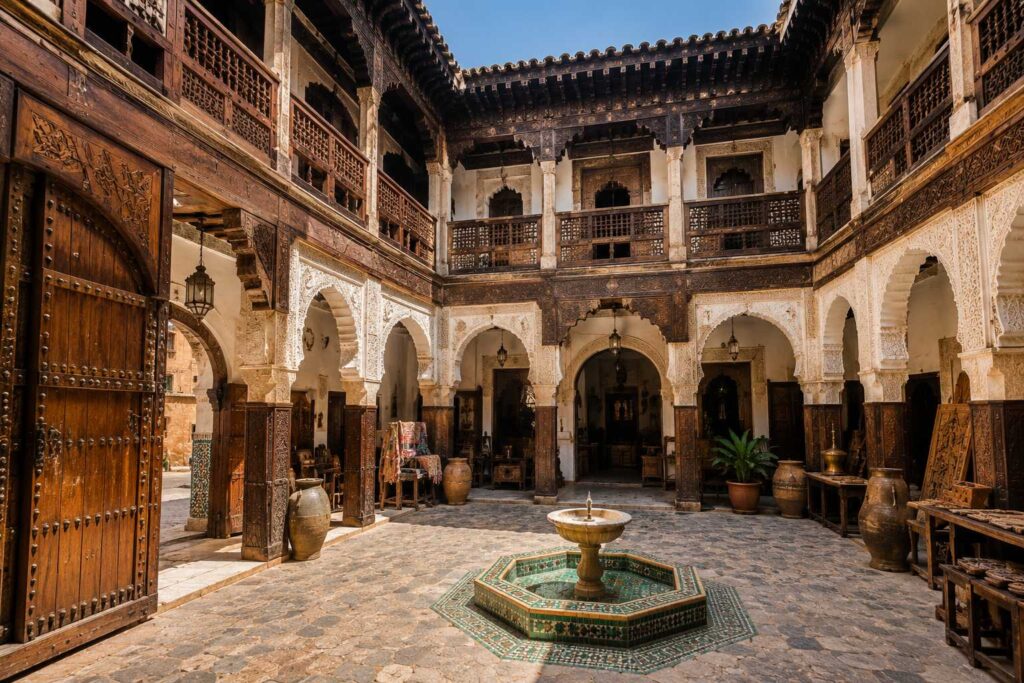
A merchant arriving at a fondouk would normally enter through a large doorway leading to the central courtyard. Goods could be unloaded on the ground floor, where storage areas and spaces for animals were generally located.
The upper floors provided rooms for merchants and other travelers. Galleries overlooking the courtyard connected these rooms and allowed people to observe the activity below.
During the day, the courtyard could become a busy working space. Packages were counted, products were inspected and deals were discussed. Craftspeople, porters, shop owners and buyers might all visit the building.
At night, the large entrance could be secured, providing greater protection than leaving goods in the street or an open market. The architecture therefore responded directly to the practical concerns of trade and travel.
At Nejjarine Fondouk, historical descriptions indicate that the ground floor was used for stables while guest rooms were placed upstairs. A nearby fountain also provided water for the animals belonging to the fondouk’s visitors.
The Traditional Architecture of Fondouks in Morocco
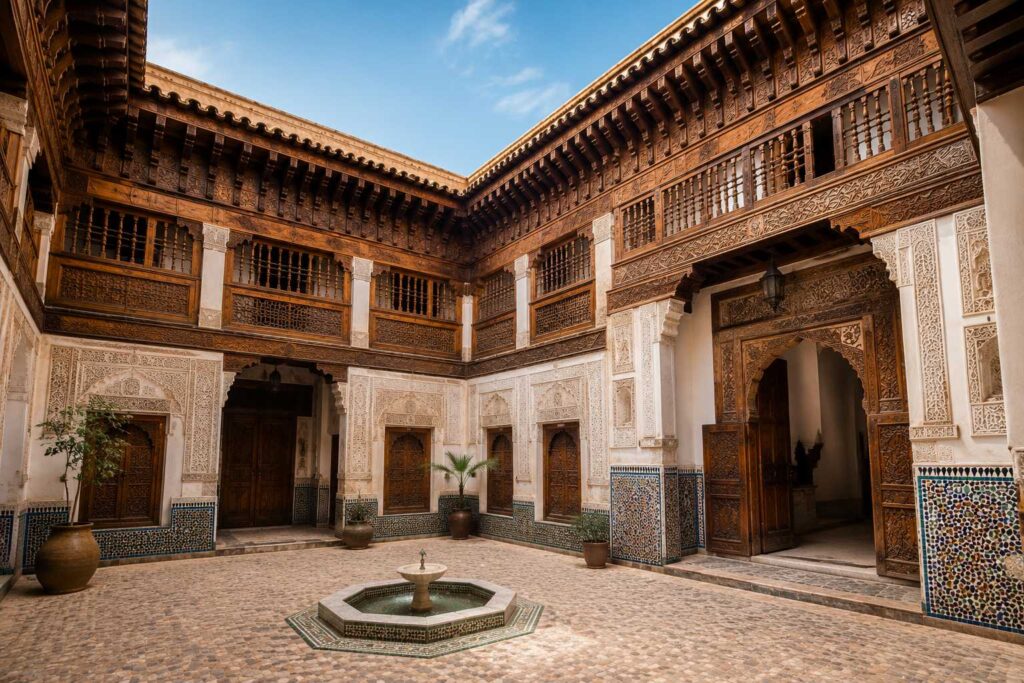
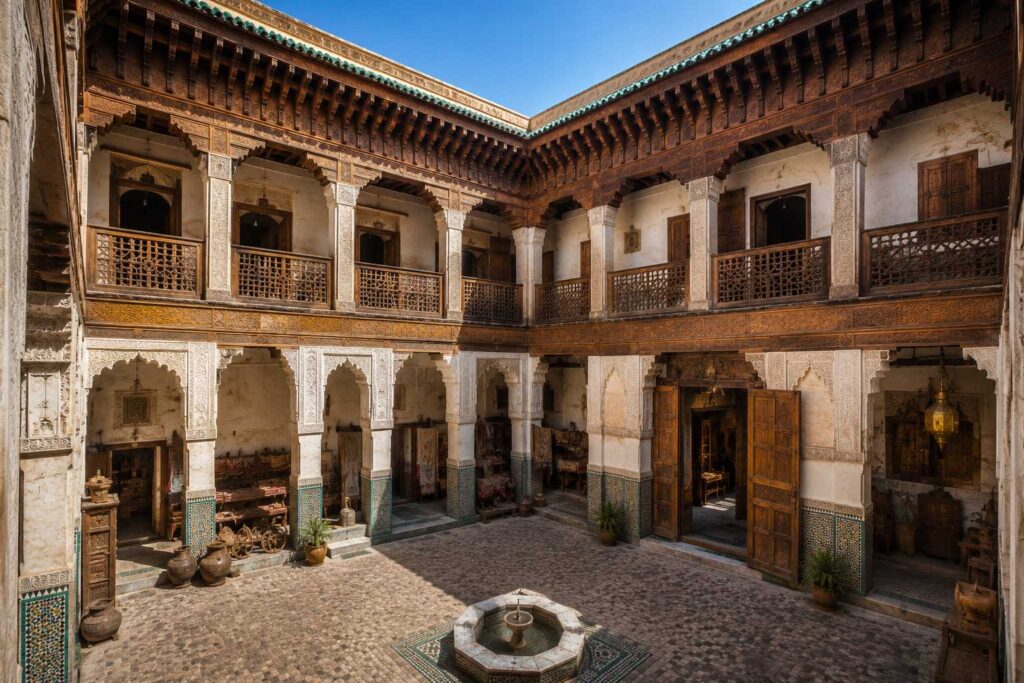
Most traditional fondouks are organized around an open central courtyard. This layout brings light and air into a building surrounded by the narrow streets and closely connected structures of the medina.
The ground floor commonly contains larger spaces suitable for animals, merchandise and heavy activity. One or more upper levels are reached by stairways and surrounded by covered galleries. Small doors along these galleries lead to rooms that were traditionally used by traveling merchants.
Fondouks were practical buildings, but important examples could also display sophisticated Moroccan craftsmanship. Entrances might include carved wood, sculpted plaster, decorative arches and zellige tilework.
The Nejjarine Fondouk has a rectangular courtyard surrounded by galleries and rooms. Its ground floor is topped by two additional levels, while its monumental entrance combines carved plaster, woodwork and decorative zellige.
The inward-facing design also created privacy and security. Much of the building’s activity remained hidden from the street, while the courtyard served as its central social and commercial space.
Why the Courtyard Was So Important
The courtyard was the heart of the fondouk. It helped organize the movement of people, animals and goods while allowing daylight to reach the interior.
Merchants could unload products directly into this shared area before transferring them to storage rooms. Buyers could inspect merchandise without entering private sleeping spaces, and workers could move between workshops and warehouses.
The open courtyard also improved ventilation. This was particularly useful in buildings containing animals, food products, leather, wool or other materials that required air circulation.
From the upper galleries, merchants could watch over the courtyard and their goods. The layout therefore connected visibility, security and everyday commercial activity.
Today, the courtyard is often the first feature that attracts visitors. Its symmetry, wooden balconies and changing natural light can make a former commercial building feel almost like a palace, even though its original purpose was highly practical.
Fondouks and the Organization of the Medina
Fondouks were not randomly placed inside Moroccan cities. They were closely connected to the organization of the medina and its different commercial districts.
Traditional souks were often arranged according to products or professions. One area might specialize in carpentry, another in leather, textiles, metalwork, spices or food. A fondouk located nearby could support the same commercial activity by providing storage, accommodation or workshop space.
This relationship explains why some fondouks became associated with specific trades. The Nejjarine area of Fez, for example, has long been connected with carpenters and woodworking crafts. The building’s later conversion into a museum of wooden arts and crafts continued that relationship.
The position of fondouks near souks also reduced the distance that heavy goods had to be carried. Products arriving from outside the city could be stored close to the people who would sell, transform or distribute them.
Fondouks in Fez
Fez is one of the best Moroccan cities for understanding the historic role of fondouks. Its old medina developed into a major political, religious, intellectual and commercial center.
The city reached an important period of growth during the thirteenth and fourteenth centuries under the Marinid dynasty. Many of the medina’s significant structures, including fondouks, date from this period. UNESCO describes Fez as one of the largest and best-preserved historic cities in the Arab-Muslim world.
As travelers walk through Fez El Bali, they pass areas that have been associated with particular crafts for generations. Tanneries, metal workshops, textile sellers and woodworkers remain part of the medina’s character.
Some fondouks are easy to miss because their entrances open onto busy streets filled with shops. Looking through a doorway may reveal a much larger courtyard, several levels of wooden galleries and artisans working inside.
Not every fondouk is open as a visitor attraction. Some remain working spaces, while others may be private, fragile or awaiting restoration.
Nejjarine Fondouk: The Most Famous Example
Nejjarine Fondouk is one of the best-known fondouks in Morocco. It stands in the old city of Fez on Nejjarine Square, an area historically associated with carpenters.
The building dates to 1711, during the reign of Sultan Moulay Ismail. It was designed as a caravanserai for merchants visiting Fez and contains a rectangular courtyard, three levels and a highly decorated entrance.
The façade is particularly impressive. Its large doorway includes carved wood, sculpted plaster, decorative arches and zellige. Across the square stands the Nejjarine fountain, which historically provided water, including for the animals used by visiting merchants.
The building was restored and opened in 1998 as the Nejjarine Museum of Wooden Arts and Crafts. Its collection includes traditional woodworking tools, everyday objects, musical instruments and other examples of Moroccan wood craftsmanship.
This transformation allows visitors to appreciate two forms of heritage at the same time: the architecture of a historic fondouk and the woodworking traditions connected to Fez.
Fondouks in Marrakech
Fondouks are also an important part of the historic medina of Marrakech. The city was founded by the Almoravids in the eleventh century and became a major political, economic and cultural center.
Its historic urban landscape includes houses, souks, fondouks and areas of traditional craft and commercial activity. UNESCO considers this combination an important example of a living historic city.
Many Marrakech fondouks are less monumental than Nejjarine Fondouk. Some are still occupied by artisans producing leather goods, metal objects, textiles, woodwork or decorative products.
A visitor may enter a courtyard and find craftspeople cutting materials, repairing objects or organizing products for nearby shops. These working fondouks show that heritage does not exist only inside museums. It can continue through daily labor and traditional skills.
The condition and accessibility of these buildings vary. Some have been restored, while others show the effects of age, changing commercial needs and pressure on the historic medina.
Fondouks in Tetouan, Rabat and Other Moroccan Cities
Although Fez and Marrakech contain some of the most familiar examples, fondouks can also be found in other Moroccan medinas.
In Tetouan, the historic urban plan connects major streets and gates with public spaces, mosques, commercial neighborhoods, craft areas and fondouks. UNESCO describes these buildings as important community monuments within the medina’s structure.
Rabat also has historic fondouks, including Fondouk Ben Aicha. Restored examples may now host cultural programs, craft activities or commercial spaces while preserving their traditional courtyard organization.
Other examples can be found in cities that historically participated in regional trade. Their size, decoration and original use may differ according to the importance of the route, the products traded and the economic character of each city.
This regional diversity makes it difficult to describe every Moroccan fondouk in exactly the same way. The common elements are their relationship with travelers, commerce, storage and the economic life of the medina.
From Merchant Inns to Artisan Workshops
The role of fondouks changed as transportation and commerce became modernized. Trucks, formal hotels and larger warehouses reduced the need for traditional merchant accommodation.
However, many fondouks remained useful because their rooms and courtyards could be adapted into workshops, storage areas or small shops.
Artisans could work in the ground-floor rooms and use the courtyard to move materials. Upper rooms could hold finished products, tools or supplies. Their location near established souks also remained commercially valuable.
This adaptation helped some buildings survive, but it could also create challenges. Buildings designed for a different period may require structural repairs, improved drainage, safer electrical systems and careful restoration.
Where traditional activity continues, travelers should remember that the fondouk is a workplace rather than simply a tourist attraction. Asking permission before entering work areas or photographing artisans shows respect for the people using the building.
The Restoration of Historic Fondouks
Restoring a fondouk involves more than improving its appearance. The work may require repairing walls, wooden galleries, roofs, stairways, plaster decoration and traditional tilework.
Conservation teams must also decide how the building will be used. A restored fondouk may become a museum, cultural center, craft space or commercial complex.
Nejjarine Fondouk is an important example of adaptive reuse. Its restoration preserved the building’s courtyard structure and architectural details while giving it a new role as a museum dedicated to Moroccan woodworking heritage.
This approach can make historic architecture accessible to the public and provide funding for maintenance. At the same time, restoration must avoid removing the features that show how the building originally functioned.
The challenge is to protect the fondouk without turning every historic medina building into the same type of polished visitor space.
How to Recognize a Fondouk in a Moroccan Medina
A fondouk may not have a large sign explaining its history. Travelers can look for several architectural clues:
- A wide entrance that could once accommodate loaded animals
- A central open courtyard
- Storage rooms or workshops on the ground floor
- One or more levels of galleries
- Small rooms opening onto the upper galleries
- A location close to a souk or traditional craft district
Not every courtyard building is a fondouk. Moroccan houses and riads also use inward-facing architecture, but their proportions and functions are different.
A riad was generally designed as a private residence centered on domestic life and often includes a garden. A fondouk was a more public and commercial structure intended for merchants, goods and work.
Local guides, museum staff and craftspeople can often provide information about a building’s previous use. They may also know names and stories that are not displayed on public signs.
What Travelers Should Know Before Visiting
Access to fondouks in Morocco depends on how each building is currently used. Museums and restored cultural spaces normally have defined entrances and visiting hours. Working fondouks may have no formal visitor system.
Travelers should avoid entering private rooms or active workshops without permission. Photographing artisans, merchandise or people should also be preceded by a polite request.
Some historic fondouks contain uneven floors, steep stairs and narrow passages. Comfortable shoes are useful, particularly during a longer medina visit.
A knowledgeable local guide can help visitors identify buildings that might otherwise be overlooked. Guides can also explain how a particular fondouk related to its surrounding souk and craft community.
Visitors should not expect every fondouk to be perfectly restored. Signs of wear are part of the complex history of buildings that have been used and adapted over many generations.
Why Fondouks Matter to Moroccan Heritage
Fondouks reveal an important side of Moroccan history that can be missed when travelers focus only on palaces, mosques and decorative monuments.
These buildings explain how cities functioned economically. They show where merchants slept, where goods were protected and how long-distance trade connected with local production.
They also demonstrate the practical intelligence of medina architecture. A single building could provide security, storage, accommodation, ventilation and access to commercial networks.
Fondouks remain important because many are connected to living craft traditions. Even when their original role has disappeared, their courtyards and rooms may continue to support carpenters, leatherworkers, textile sellers and other artisans.
In Fez, Marrakech and Tetouan, international heritage recognition includes fondouks as part of the historic urban landscape rather than treating them as isolated buildings.
1.
What is a fondouk in Morocco?
A fondouk is a traditional building that provided accommodation for traveling merchants, storage for their goods and shelter for transportation animals. Many fondouks were built around a central courtyard with storage areas below and guest rooms above.
2.
Where can travelers see fondouks in Morocco?
Fondouks can be found in several historic Moroccan medinas, especially Fez and Marrakech. Examples also exist in Rabat, Tetouan and other cities connected to traditional trade routes.
3.
What is the most famous fondouk in Morocco?
Nejjarine Fondouk in Fez is one of the best-known examples. Built in 1711, it has been restored and now contains the Nejjarine Museum of Wooden Arts and Crafts.
4.
Are fondouks still used today?
Some fondouks are still used as workshops, storage spaces or small commercial buildings. Others have been restored and converted into museums, cultural centers or visitor attractions.
5.
What is the difference between a fondouk and a riad?
A fondouk was mainly a commercial building used by merchants, goods and animals. A riad was generally a private residence organized around an interior garden or courtyard. Although both may have inward-facing architecture, their original purposes were different.
Fondouks in Morocco tell the story of movement, trade and everyday life inside the country’s historic medinas. They once gave merchants a secure place to sleep, store their goods and care for the animals that carried products between distant regions.
Their courtyards connected travelers with local buyers, craftspeople and markets. Their architecture combined simple commercial needs with the decorative traditions of Moroccan woodwork, plaster and zellige.
Today, fondouks continue to serve Morocco in different ways. Some remain active artisan spaces, while others have become museums or cultural centers. Together, they preserve the memory of a time when every journey, product and commercial relationship passed through the narrow streets of the medina.
For travelers, entering a fondouk can transform the way a Moroccan old city is understood. Behind an ordinary doorway may be a building that once connected distant trade routes with the workshops, markets and communities of Morocco.
When visiting a Moroccan medina, would you prefer to explore a carefully restored fondouk or discover one that is still being used by local artisans?