
Berber (Amazigh) Culture and Villages of the Atlas Mountains
The Atlas Mountains are more than one of Morocco’s most spectacular landscapes. They are also home to communities whose traditions, languages, architecture, agriculture, music, and hospitality have shaped the region for centuries.
For travelers, discovering Berber (Amazigh) culture and villages of the Atlas offers an opportunity to experience a side of Morocco that goes far beyond the country’s famous imperial cities and tourist attractions.
Today, the word Amazigh is increasingly used to describe the Indigenous peoples of North Africa, while “Berber” remains widely used in tourism and everyday conversation. In Morocco, Amazigh communities live across several regions, including the High Atlas, Middle Atlas, Anti-Atlas, and surrounding valleys.
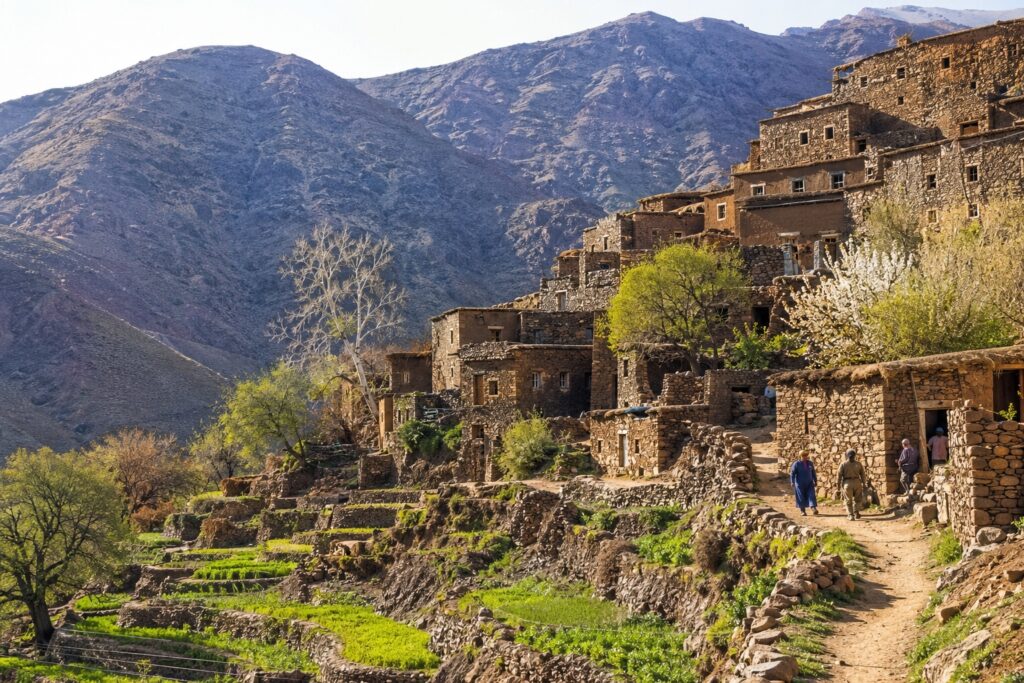
In the Atlas Mountains, villages appear among dramatic peaks, terraced fields, walnut trees, rivers, and deep valleys. Houses are often built from local earth and stone, while agriculture remains an important part of rural life.
A journey through the mountains can therefore become a cultural experience as much as an adventure.
You might walk through an Amazigh village near Imlil, share mint tea with a local family, visit a traditional home, learn about mountain agriculture, taste locally produced food, or hike between villages while your guide explains the history and customs of the communities around you.
Whether you are planning a short excursion from Marrakech or a longer Morocco adventure, discovering Berber (Amazigh) culture and villages of the Atlas can make your journey more meaningful, personal, and memorable.
Berber (Amazigh) Culture and Villages of the Atlas: Who Are the Amazigh?
The Amazigh are Indigenous peoples of North Africa, with communities across Morocco, Algeria, Tunisia, Libya, and other parts of the region.
In Morocco, Amazigh heritage is particularly important to the country’s cultural identity.
The term Amazigh is generally preferred by many people because “Amazigh” refers to the Indigenous identity, while “Berber” is a historical term that became widely used by outsiders.
Amazigh languages in Morocco
Morocco is linguistically diverse.
Amazigh languages form an important part of the country’s cultural heritage, alongside Moroccan Arabic and other languages spoken throughout the country.
Three major Amazigh varieties are commonly associated with Morocco:
- Tashelhit, widely spoken in the Souss region and parts of the High and Anti-Atlas
- Central Atlas Tamazight, spoken across much of the Middle Atlas and surrounding areas
- Tarifit, associated primarily with the Rif region
In the High Atlas, visitors may hear Amazigh languages spoken in homes, village shops, cafés, markets, and during local celebrations.
Language is not simply a communication tool. It carries stories, songs, traditions, place names, and cultural memory from one generation to another.
Amazigh identity and traditions
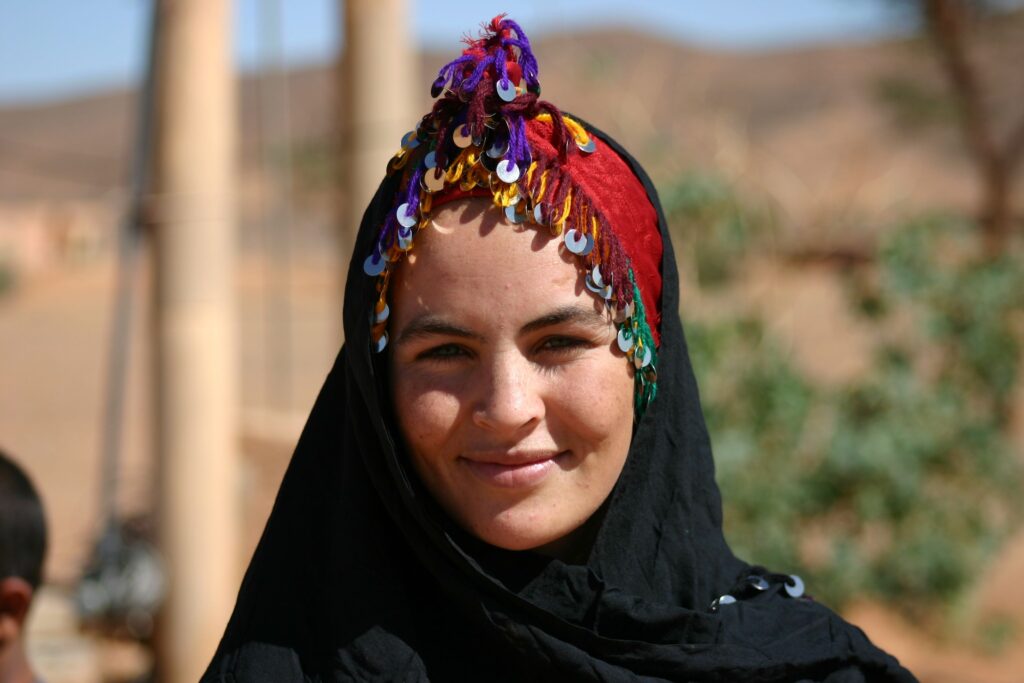
Amazigh culture is not a single uniform tradition.
Customs vary from one region and community to another.
However, many Amazigh communities share strong traditions involving:
- Family and community
- Hospitality
- Agriculture
- Music and poetry
- Handicrafts
- Oral storytelling
- Traditional clothing
- Local architecture
- Seasonal celebrations
- Connection to the land
Travelers should therefore think of Amazigh culture as a collection of diverse regional traditions rather than one single lifestyle.
Berber (Amazigh) Culture and Villages of the Atlas Mountains
One of the best ways to understand Amazigh culture is to visit the villages where these traditions remain part of everyday life.
The High Atlas is filled with settlements built into valleys and mountain slopes.
Some villages are easily accessible from Marrakech, while others require longer hikes or 4×4 journeys.
Imlil and the surrounding villages
Imlil is one of the best-known mountain villages in the High Atlas.
Located south of Marrakech, it is an important starting point for hiking routes toward Mount Toubkal and the surrounding valleys.
But Imlil is more than a hiking base.
The surrounding communities offer travelers opportunities to see traditional mountain life, agricultural terraces, local homes, small guesthouses, and village markets.
A guided walk can provide much more cultural insight than simply driving through the area.
Aroumd
Aroumd, sometimes written as Armed, is another well-known village near Imlil.
The village is surrounded by dramatic mountain scenery and traditional agricultural landscapes.
Walking between Imlil and Aroumd allows travelers to experience the gradual transition from roads and tourist facilities to quieter mountain communities.
Asni
The town of Asni sits in the foothills of the High Atlas and is known for its local market.
Market days can provide a fascinating glimpse into regional commerce, where farmers, traders, and residents come together to buy and sell agricultural products, livestock, clothing, household goods, and other items.
For travelers interested in authentic everyday life, local markets can be more revealing than heavily visited monuments.
Ourika Valley villages
The Ourika Valley, within reach of Marrakech, is another area where travelers can discover Amazigh communities and mountain landscapes.
Villages are scattered along the valley, often surrounded by terraced agriculture and dramatic slopes.
A trip through the Ourika Valley can combine:
- Mountain scenery
- Village visits
- Local food
- Hiking
- Waterfalls
- Traditional homes
- Agricultural landscapes
- Amazigh hospitality
For visitors with limited time in Morocco, the Ourika Valley provides an accessible introduction to the High Atlas.
Moroccan Trips also offers a Day Trip to Ourika Valley from Marrakech as part of its Marrakech excursions.
Traditional Amazigh Houses and Atlas Mountain Architecture
Architecture is one of the most visible expressions of Berber (Amazigh) culture and villages of the Atlas.
As you travel through mountain valleys, you will notice houses and settlements that seem to grow directly from the landscape.
Building with local materials
Traditional mountain houses were generally constructed using materials available locally, including:
- Earth
- Stone
- Mud
- Wood
- Clay
This approach helped communities build homes suited to their environment without relying on modern industrial materials.
The color of the buildings often blends naturally with the surrounding mountains.
Villages adapted to the landscape
Mountain villages are rarely arranged in a perfectly planned grid.
Instead, homes, terraces, paths, and agricultural areas follow the contours of the terrain.
This creates a distinctive landscape where architecture and nature appear interconnected.
Kasbahs, fortified houses, and communal spaces
Depending on the region, travelers may encounter fortified houses, communal structures, old granaries, and traditional compounds.
These buildings reflect the practical needs of communities that historically lived in remote mountain environments.
They also demonstrate how architecture can respond to climate, geography, security, and agricultural life.
Modern life in traditional villages
It is important not to imagine Atlas villages as frozen in the past.
Many communities have modern homes, electricity, internet access, schools, vehicles, and contemporary businesses.
Traditional architecture and modern life exist side by side.
This combination is an important part of understanding Morocco today.
Life in the Atlas Mountains: Agriculture, Food, and Daily Traditions
The mountains can look rugged and dry from a distance, but valleys often support productive agricultural systems.
Water from springs, rivers, and mountain sources allows communities to cultivate crops on terraces and valley floors.
Terraced agriculture
Terraces are an important feature of many Atlas landscapes.
Farmers have adapted steep terrain to grow crops and manage water.
Depending on altitude and region, agricultural products can include:
- Barley
- Wheat
- Corn
- Vegetables
- Olives
- Almonds
- Apples
- Walnuts
- Figs
- Apricots
The agricultural calendar naturally changes with altitude and climate.
Walnut trees and mountain valleys
Walnut trees are particularly characteristic of parts of the High Atlas.
In some villages, enormous old walnut trees provide shade beside paths, houses, and fields.
Their presence is not simply decorative.
Walnuts have traditionally been an important food and agricultural resource for mountain communities.
Traditional Moroccan and Amazigh food
Food provides another direct connection with local culture.
Depending on the village and season, travelers may encounter dishes prepared with locally available ingredients.
Common foods include:
- Tagine
- Couscous
- Fresh bread
- Olive oil
- Seasonal vegetables
- Local fruit
- Nuts
- Mint tea
In mountain communities, meals can be particularly memorable when prepared by a local family or small guesthouse.
Mint tea and Amazigh hospitality
Tea is an important part of Moroccan hospitality.
A cup of Moroccan mint tea offered during a village visit can become one of the simplest yet most memorable moments of a mountain journey.
The experience is not simply about the drink.
It is about conversation, hospitality, and taking time to connect with people.
Travelers should approach these experiences respectfully rather than treating a family home as a tourist attraction.
Berber (Amazigh) Culture and Villages of the Atlas Through Music and Craftsmanship
Amazigh cultural traditions are also expressed through music, textiles, jewelry, pottery, and other forms of craftsmanship.
Amazigh music
Music has an important place in Amazigh cultural life.
Songs can communicate stories, emotions, celebrations, historical memories, and community identity.
Different regions have their own musical styles and traditions.
Travelers may encounter local performances during festivals, weddings, cultural events, or community celebrations.
Traditional clothing
Traditional clothing varies significantly by region.
Color, embroidery, jewelry, fabrics, and accessories can communicate regional identity and cultural heritage.
Amazigh jewelry, particularly silver jewelry, is also widely recognized as an important form of North African craftsmanship.
Carpets and weaving
Amazigh women in many Moroccan communities have historically played an important role in textile production.
Handwoven carpets can contain geometric designs and patterns associated with particular communities or regions.
Each piece can therefore represent more than decoration.
It may reflect the creativity, symbolism, history, and personal expression of the person who made it.
Buying crafts responsibly
If you purchase a carpet, textile, piece of jewelry, or other handicraft, consider asking about its origin and how it was made.
Supporting genuine local artisans and cooperatives can help keep traditional crafts economically viable.
Visiting Amazigh Villages Responsibly
Cultural tourism can create valuable connections between travelers and local communities, but it should be approached thoughtfully.
A village is someone’s home.
It is not an open-air museum.
Ask before photographing people
Always ask permission before taking close-up photographs of people.
Children deserve particular consideration.
A beautiful travel photograph is never more important than someone’s privacy.
Hire local guides
A knowledgeable local guide can transform a mountain walk into a cultural experience.
Instead of simply pointing out mountains and waterfalls, a local guide can explain:
- Village history
- Agriculture
- Local architecture
- Amazigh traditions
- Regional food
- Mountain ecology
- Cultural etiquette
This also helps ensure tourism income reaches local communities.
Stay in locally owned accommodation
Guesthouses and family-run accommodations can provide a more personal experience than large hotels.
You may have the opportunity to eat home-cooked food, speak with local hosts, and learn more about daily life in the mountains.
Avoid turning poverty into entertainment
Not every traditional-looking house or rural community should be presented as an exotic attraction.
A responsible traveler focuses on people, culture, resilience, craftsmanship, and hospitality rather than romanticizing hardship.
Hiking Through Berber (Amazigh) Villages of the Atlas
Hiking is one of the best ways to experience the mountains.
Driving allows you to see the scenery.
Walking allows you to understand it.
Mountain trails connect villages, agricultural terraces, valleys, forests, and high-altitude landscapes.
The Imlil valley
The Imlil area offers numerous walking opportunities for different fitness levels.
Some routes are relatively gentle and connect nearby villages, while others climb toward higher mountain terrain.
A local mountain guide can help choose a route based on:
- Fitness level
- Available time
- Weather
- Season
- Hiking experience
- Desired cultural experiences
Mount Toubkal
At 4,167 meters, Mount Toubkal is the highest peak in Morocco and North Africa.
The ascent is significantly more demanding than a simple village walk.
Travelers attempting the summit should prepare appropriately and use experienced mountain professionals.
For travelers who are more interested in culture than mountaineering, there is no need to climb Toubkal to appreciate the High Atlas.
Village walks can provide an equally meaningful cultural experience.
Walking between villages
One of the most rewarding experiences is following a trail between small settlements.
You may pass farmers working in fields, children walking home from school, mule trains carrying supplies, and families tending orchards.
These everyday scenes provide a more authentic understanding of mountain life than simply visiting a viewpoint.
Berber (Amazigh) Culture and Villages of the Atlas From Marrakech
For most international travelers, Marrakech is the easiest gateway to the High Atlas.
The mountains rise dramatically south of the city, making it possible to leave the busy medina in the morning and reach a mountain village within a few hours.
This makes the Atlas particularly convenient for travelers who want to combine urban culture with rural experiences.
A day trip from Marrakech
A day trip can introduce you to the mountains through destinations such as the Ourika Valley or Imlil.
A typical experience may include:
Marrakech → Atlas Mountains → Amazigh villages → local lunch → mountain walk → return to Marrakech
This option works well for travelers with limited time.
A longer Atlas experience
If you have more time, consider spending a night in the mountains.
An overnight stay allows you to experience:
- Quiet mountain evenings
- Sunrise over the peaks
- Local breakfasts
- Longer village walks
- Family-run accommodation
- Slower travel
- Deeper cultural interaction
Combining the Atlas with the Sahara
For travelers who want to experience more of Morocco, the Atlas Mountains can be the beginning of a journey toward the desert.
Moroccan Trips’ 3 Days Marrakech Desert Tour crosses the High Atlas before continuing toward Aït Ben Haddou, Ouarzazate, Dades Valley, Todra Gorge, and the Merzouga desert.
The 3 Days Desert Tour from Marrakech to Fes also begins by crossing the High Atlas and continues through southern Morocco toward the Sahara before ending in Fes.
For a slower itinerary, the 5 Days Tour from Marrakech to Desert provides additional time to experience the landscapes and cultural stops between Marrakech and Merzouga.
The Atlas Mountains as Part of a Longer Morocco Journey
One of the best things about the Atlas Mountains is that they connect several of Morocco’s major travel regions.
A journey can begin in Marrakech and continue through the mountains toward southern Morocco.
From there, travelers can discover:
Aït Ben Haddou
This historic fortified settlement is one of Morocco’s most famous architectural landmarks and an important stop on routes crossing the High Atlas.
Ouarzazate
Known for its film studios and dramatic landscapes, Ouarzazate provides a gateway between the mountains and the desert.
Dades Valley
The valley combines spectacular rock formations, agricultural landscapes, and traditional settlements.
Todra Gorge
The enormous canyon walls create one of the most dramatic landscapes in southeastern Morocco.
Merzouga and Erg Chebbi
Eventually, the road reaches the Sahara, where travelers can experience camel trekking, desert camps, traditional music, and spectacular sunsets.
A longer journey can therefore connect Amazigh mountain villages with the Sahara, demonstrating how diverse Morocco’s landscapes and cultures can be within one itinerary.
For travelers interested in combining mountain communities, desert landscapes, and cultural experiences, Moroccan Trips also offers a 4 Days Marrakech to Fes Desert Tour crossing the High Atlas and continuing through southern Morocco toward the Sahara and Fes.
Best Time to Experience Amazigh Villages in the Atlas
The Atlas Mountains can be visited throughout the year, but conditions vary significantly with altitude.
Spring
Spring is one of the most attractive seasons for mountain walks.
Temperatures are generally comfortable, and valleys can become particularly green.
Summer
Summer can be hot in Marrakech and lower elevations, while higher mountain areas can offer cooler conditions.
Early morning walks are often more comfortable.
Autumn
Autumn is another excellent season for hiking and cultural exploration.
The weather can be comfortable, and mountain landscapes take on beautiful seasonal colors.
Winter
Winter brings snow to higher elevations.
This can create spectacular scenery, but mountain roads and trails may require additional preparation.
Travelers planning high-altitude hikes should always check current weather and trail conditions.
How to Experience Amazigh Culture Respectfully
The most meaningful cultural experiences happen when travelers approach communities with curiosity and respect.
Learn a few basic Moroccan Arabic or Amazigh greetings.
Ask questions rather than making assumptions.
Listen when local people explain their traditions.
Support local guides, guesthouses, restaurants, and artisans.
And remember that cultural exchange should benefit both visitors and hosts.
What should you wear?
There is no single dress code for Atlas villages, but modest clothing is generally appreciated.
Comfortable trousers or longer skirts, shirts that cover the shoulders, and appropriate hiking clothing are practical choices.
Mountain weather can change quickly, so layers are recommended.
What should you bring?
For a mountain village experience, consider bringing:
- Comfortable walking shoes
- Water
- Sun protection
- A light jacket
- Layers
- Small cash
- A reusable water bottle
- Camera
- Basic first-aid supplies
If you are hiking at higher elevations, prepare according to the route and season.
Frequently Asked Questions About Berber (Amazigh) Culture and Villages of the Atlas
Some of the most accessible areas for experiencing Amazigh culture include Imlil, Aroumd, Asni, and the Ourika Valley in the High Atlas. Visitors can explore villages, walk through agricultural landscapes, meet local guides, experience traditional food, and learn about regional customs.
Yes. The High Atlas Mountains are easily accessible from Marrakech, making destinations such as Imlil and the Ourika Valley popular choices for day trips and longer stays. A guided excursion can combine mountain scenery with village walks and cultural experiences.
Amazigh is the term many Indigenous North Africans use for themselves and their identity, while Berber is a historical term that remains widely used internationally and in tourism. In Morocco, Amazigh communities have diverse languages and traditions that vary by region.
Expect a living mountain community rather than a traditional tourist attraction. You may see agricultural terraces, local homes, small shops, village paths, and everyday activities. With a local guide or host, you may also experience traditional food, tea, crafts, and conversations about mountain life.
Yes. The Atlas Mountains are naturally positioned along several routes from Marrakech toward southern Morocco and the Sahara. A multi-day itinerary can combine Amazigh villages and mountain landscapes with Aït Ben Haddou, Ouarzazate, Dades Valley, Todra Gorge, and Merzouga.